Irish Northern Aid
News

 |
||||
http://www.belfasttelegraph.co.uk/breaking-news/ireland/politics/mcguinness-condemns-perpetrators-of-belfast-attack-14534990.html
Sinn Fein's Martin McGuinness has condemned those responsible for yesterday's bomb attack on the partner of a PSNI officer.
The woman escaped with minor injuries after the device exploded beneath her car as she reversed out of her driveway in east Belfast. The bomb was planted on the passenger side of the vehicle and the police say anyone sitting there would have been killed. The police are investigating who the intended target was, but the woman who was hurt in the blast is believed to regularly give her partner a lift to work.
Dissident republicans are the most likely suspects for the attack.
The bombing has drawn widespread condemnation, with First Minister Peter Robinson describing the perpetrators as "evil".
Mr McGuinness, meanwhile, says they have no support in the community and should respect the will of the majority of people in Ireland who want the political progress of recent years to continue.
He says those responsible for yesterday's attack need to understand that their actions are "futile".
http://www.belfasttelegraph.co.uk/opinion/bomb-is-intended-to-spread-fear-14534759.html
The one thing about this incident in east Belfast that had the police scratching their heads was where it happened.
“It’s way out of their area of activity,” one source said.
He meant this was somewhere different for the dissidents — not far from police headquarters, not far from Stormont and in Peter Robinson’s constituency.
“Right on your own doorstep,” was how another source described it — meant to cause maximum fear.
Yesterday was about much more than putting a bomb under a car. It was about sending out messages.
The dissidents are trying to kill again — that is obvious, and still trying to derail the political and peace processes. “This is going to unsettle unionism,” one source said.
In its wider purpose, that is exactly what that bomb yesterday was intended to do.
The woman driving the car — the partner of a police dog handler — was very lucky.
That bomb was meant to do much more damage.
So was another dissident bomb in another recent attack in Belfast. On that occasion, the device is understood to have fallen from a vehicle.
The Real and Continuity IRA and the group calling itself Oglaign na hEireann are now operating in a wider frame — spreading their activity and spreading fear.
We had been told from inside the security world that these groups had “upped their operational tempo” — that their constant focus now is targeting and attack planning.
It is not just unionists who will be unsettled by this latest development.
Think of the reaction inside the police world, and how much more checking is going to be done around houses and under cars by police officers and those closest to them.
The threat is both on-duty and off-duty — and it could have wider consequences.
Jackie McDonald — the UDA brigadier — told this newspaper: “Everybody needs to be very careful here.”
He said the bomb was intended to have a double message — “an attack on the PSNI in a unionist area”.
“The only thing they (the dissidents) can achieve here is death and destruction,” he continued. They cannot achieve a united Ireland.
“The dissidents are trying to get loyalist paramilitaries to attack ordinary Catholics. Then that opens the whole lot up,” the senior loyalist said.
The dissidents emerged in bomb attacks in Moira and Portadown in the constituencies of Jeffrey Donaldson and David Trimble in 1998.
They were trying to damage the political and the peace processes. More than a decade later, they are still trying.
http://www.belfastmedia.com/news_article.php?ID=3715
Andersonstown News Monday 15th of October 2009
A group of community representatives and members of An Garda Siochána from Dublin’s Tallaght area will be in West Belfast this week for a visit organised by the West Belfast District Policing Partnership.
The delegation will be hosted by members of the West Belfast DPP and will hear from a host of different groups performing vital work in the West of the city, including the Belfast Conflict Resolution Consortium, Suicide Awareness, the West Belfast Community Safety Forum and Community Restorative Justice.
The visit is a follow-up on a West Belfast DPP visit to Tallaght in May this year.
The group from Tallaght will also be given a guided tour of West Belfast as part of their visit.
Ballymurphy Sinn Féin Councillor Maire Cush, who is a member of the West Belfast District Policing Partnership, said: “We are delighted to welcome the delegation from our capital city who are coming up to West Belfast this week.
“Members of the West Belfast DPP, including myself, visited Tallaght in May, and strong links are being developed.
“For too long institutions and organisations in the North of Ireland have looked east and forgot that this country has 32 counties, not six.
“This has to change and we hope that the delegation of community representatives and members of An Garda Siochána will gain from listening to the experiences of community leaders from West Belfast who provide a great service in suicide awareness, in interface work and on community safety issues.
“We have learnt from the Tallaght delegation about their experiences and the great work they do in their areas.
“This is a good initiative and part of changing policing and the relationship between the police and the community.’’
http://www.belfasttelegraph.co.uk/opinion/ulster-should-keep-eye-on-any-move-towards-scottish-split-14534061.html
The SNP threatens to make David Cameron the first Prime Minister without a mandate in Scotland for 303 years. And the shockwaves will extend to Belfast, writes Hamish Macdonel
When he stands up to address the SNP conference tomorrow, Alex Salmond will tell his party that the target of 20 Westminster seats - three times more than it has at the moment - is within its grasp.
He will then raise the prospect of Parliament "being hung by a Scottish rope". This is his own, rather sinister image, one he floated first just a few days ago. It is a rather graphic illustration of his simple strategy: get 20 seats in a parliament which is hung and the SNP could exert significant influence on the governing party.
Mr Salmond wants those 20 seats, not as an end in itself, but as a lever to wrest concessions from the UK Government, be it Conservative or Labour, after the election and there is really only one concession he is interested in: a referendum on independence.
Anyone looking at all this scheming and plotting from the other side of the Irish Sea might be tempted to dismiss it as a sideshow that has nothing to do with Northern Ireland or its future, but they would be wrong.
While it is true that Mr Salmond and the SNP are focused purely on breaking Scotland away from the United Kingdom, the reverberations from the progress they make will be felt in Belfast and Dublin.
Just imagine for a second that Scotland did what Mr Salmond wants and split from the UK. It would keep the Crown, the pound and, possibly, even some UK military bases.
And just imagine what would happen if it made this new system work - that would inevitably lead to calls in other parts of the UK for a similar division.
Now, at the moment, the polls suggest the SNP would not win an independence referendum, but who knows what would happen after a year or so of sustained aggravation between the Scottish government in Edinburgh and a Conservative government in London.
Indeed, it is not hard to see how the north-south axis over Hadrian's Wall might become strained. If, as expected, David Cameron wins the election, he will do so without much help from his Scottish party.
The Conservatives have one seat in Scotland at the moment and while they may double this to two or even, if they have a very good campaign, three, that still represents a negligible return from a country with 59 constituencies up for grabs.
What that means is that the Conservatives will be seen by some to be ruling Scotland by default, setting policies in Westminster that were not voted for by the vast majority of Scots.
The incoming Conservative government is also likely to impose tough public spending cuts on Scotland, which is more reliant on the public sector than England. This will all create tensions and the SNP will be quick to exploit them.
So, while observers in Northern Ireland might tune off from the SNP conference, seeing it as nothing more than a distraction from the real issues of the economy or Afghanistan, they should see the bigger picture.
Mr Salmond has a clear and well-defined strategy. It is to get 20 seats, squeeze a referendum on independence from the incoming Conservative government, exploit grievances with that government - claiming it has no mandate in Scotland - and change the mood of the country in favour of independence.
Mr Cameron used his conference speech last week to stress his absolute commitment to the Union, the whole Union of the United Kingdom. He knows how the fracturing of one part of it, along Hadrian's Wall, would impact on the rest.
He is very aware that he cannot ignore the Scottish Nationalists if he wants to keep the Union intact because, if one part goes, it will be much, much harder to keep the rest intact.
The north-south axis in the UK may seem irrelevant to the people of Belfast or Broughshane, but if that goes cheaply, what price on the east-west axis going the same way?
http://breakingnews.iol.ie/news/ireland/orangemen-form-group-to-oppose-papal-visit-430444.html
Some Orange Order members have formed a group to oppose any possible Papal visit to the North.
There is speculation that Benedict XVI will travel to the North when he visits the UK next year.
However, a new group calling itself Orange Reformation is urging the leadership of the Orange Order to speak out publicly against any such move.
It claims around 150 people have attended meetings in recent weeks arranged to oppose a Papal visit.
Last month, DUP Assembly member Ian McCrea said Benedict would feel "the vent of Protestant anger" if he visited the North.
Mr McCrea said the majority of people in the North were Protestants and belonged to denominations that believe the Pope is the Antichrist.
http://www.guardian.co.uk/theguardian/2009/oct/10/martin-mcguinness-interview
The Guardian, Saturday 10 October 2009
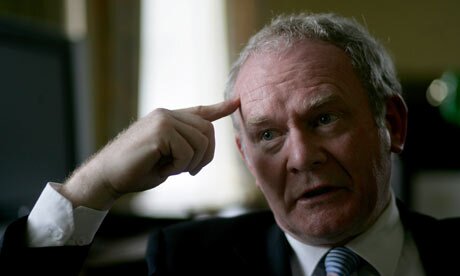
Northern Ireland's deputy first minister Martin McGuinness in his offices at Stormont
One would think, given that he is the second most powerful man in the Northern Irish government, that the security detail at Stormont might have some idea where to find Martin McGuinness, or at least Martin McGuinness's office. But apparently not: it takes a certain amount of guesswork, and two wrong tries – Stormont House, for much of the century official residence of the Speaker of the House of Commons of Northern Ireland, and Parliament Buildings, a shining white edifice perched at the top of a sweeping, horse-chestnut-lined drive – before the photographer and I eventually find ourselves at Stormont Castle, where the first joint act of first minister Ian Paisley and deputy first minister McGuinness was to ask the British direct rule minister Peter Hain to leave. Within four days he and his staff had gone. Apparently, they even took the light bulbs.
One of the great surprises of those first few months in 2007 was, of course, how famously the two men got on, how rapidly they became poster boys for the possibility of rapprochement. But Paisley stepped down in May 2008, and his successor, Peter Robinson, seems to have less interest in maintaining such appearances. Relations in the past few weeks have been increasingly fractious – over plans for increasing community cohesion, for example (the irony is lost on no one). Robinson launched his proposals without telling McGuinness, in a speech at Ulster Hall in Belfast; McGuinness has accused Robinson and the Democratic Unionist party of "spending too long in Disneyland", a jibe Robinson called "cheap and nasty"; the Chuckle Brothers, some say, seem to be being replaced by the Brothers Grimm.
"I had a good working and personal relationship with Ian Paisley, and I also have a good personal relationship with Peter Robinson," says McGuinness, pointedly. He is strikingly still in his maroon armchair, tight-wound; all the energy that in other people might be dissipated by punctuating sentences with hand movements, for example, seems concentrated in his eyes. "Over the course of the summer period the DUP appear to have hardened their position in relation to Sinn Féin. I believe that's directly related to the European election result, when Sinn Féin emerged as the largest party in the north and the unionist vote split three ways. I think it is a serious mistake on their part."
Robinson's speech, he says, "effectively called for the binning of both the Good Friday and the St Andrews agreements – certainly the cross-community voting arrangements. It was harking back to an age when a unionist block could dictate the pace at parliament here, and in government." No doubt Robinson would disagree with this interpretation, but both men know the stakes are high – and that they are not really, at the moment, about community cohesion.
At issue is when, exactly, and how, the devolution of policing and justice (McGuinness, almost robotic in his concentration, says it all as one word – "thetransferofpowerofpolicingandjustice") as promised in the St Andrew's agreement, is to occur: before Christmas, according to Sinn Féin, or at an indefinite point after, according to the DUP, who have been employing various foot-dragging tactics. Gordon Brown was at Stormont on Monday; McGuinness and Robinson at Downing Street on Thursday – the sixth such meeting in three weeks and the third this week. Late Thursday night a £600m-plus package was hammered out; each party now has to sell it to their rank and file.
If they fail, and negotiations drag on until the British general election, Sinn Féin may well have to deal with a less congenial Conservative government (in which, it has been suggested, ex-Ulster Unionist party leader David Trimble may be offered a cabinet post). How would he deal with that? "I think whatever government is elected has a bounden duty to stand by the entirety of both the Good Friday and St Andrew's agreement." A pause. "The Conservatives don't have a good track history on the north of Ireland, but that's not a judgment on David Cameron or those he would appoint to represent him. I think that Tony Blair showed himself to be the first British prime minister in the history of Britain's relationship with the north of Ireland to seriously make the effort to understand what was wrong here and what was required to put it right. The Conservatives will do a grave disservice to this process if they don't make a similar effort.
"All I know is that I have had a number of conversations with Owen Paterson, who is the shadow secretary of state for Northern Ireland, and on each occasion he has reiterated that the Conservative party would stand solid behind both the Good Friday and the St Andrew's agreements. So I take people at their word. If they break their word, then we're in a different ball game."
It is hard to imagine now, but McGuinness grew up in an unpolitical household in relatively unpolitical Derry – "in the late 1960s," as Ed Moloney puts it in A Secret History of the IRA, "the number of republicans in Derry could be counted on the fingers of one hand." The provisional IRA was mostly a concept, the Royal Ulster Constabulary and the British army not necessarily enemies. McGuinness was one of seven children: six boys and a girl; the family house in the Bogside had only two bedrooms, an outside toilet, and, he says, laughing for the first time in our interview, "the tiniest kitchen you ever saw in your life, with what we call a jawbox in it, which would now be known as a Belfast sink".
McGuinness's mother was from Donegal, but moved to Derry to work in a shirt factory. Until she died last year, he called her every day, whether he was on the run, in prison, or travelling on government business; she hemmed the trousers he wore on his first day as education minister (they had belonged to his taller brother, an all-Ireland football star). His father, who died in 1973, worked at an iron foundry, "which was like coal-mining, only above ground. He'd come home from his work covered in dirt and dust as a miner would be, and wash himself down and go off to half-seven mass every day of his life".
McGuinness is still a practising Catholic, though his job means he can't attend mass quite as often. He is abstemious – he once said that the last time he was drunk was in 1972 – enjoying, instead, chess, and fly-fishing, and, occasionally, writing poems: his gift to Paisley when he stepped down as first minister was a framed copy of a poem about disappearing sea-trout: "The lilac creature lay silent and unmoving / As the peaty water flowed over the last of the mohicans. / Stones were the wigwam in a Donegal river / For a decimated breed of free spirits." He will not, he admits, be giving Seamus Heaney a run for his money any time soon.
School, run by the Christian Brothers, could be brutal, and he left as soon as he could. In 1965 he applied for a job as a mechanic. He has said the interview consisted of three sentences: "What's your name?", "What school did you go to?" and "Out the door." So, in a move that has made for some predictable headlines over the years, he became a trainee butcher.
But then came the civil rights movement, increasingly quashed, in Northern Ireland, by the RUC and the B Specials (volunteer officers of the Ulster Special Constabulary). Membership of the Provisional IRA stayed small for a while – a dozen or so people, McGuinness once estimated – but the British policy of internment, introduced in 1970, changed that. Applications to join doubled, tripled, quadrupled by the week.
McGuinness says he was radicalised by seeing the dead body, in July 1971, of 19-year-old Desmond Beattie: British troops had claimed that he and a friend, Seamus Cusack, had been about to throw gelignite bombs; their Bogside neighbours knew this was not true. He joined the Officials, then, in frustration, the more active Provisionals, and rose swiftly: shortly after Bloody Sunday he was made OC, or officer commanding, for Derry; in those years the IRA killed 27 soldiers and Derry came to look as though it had been bombed from the air. An informer who was a member of the Derry IRA at the time later told a British newspaper, that "he demanded total commitment and support from subordinates, and he got it … once he'd made up his mind, that was it – he might be all smiles but nobody ever crossed Martin twice."
Although the British government insisted it would never negotiate with terrorists, McGuinness – then only 22 – and Gerry Adams were flown to London for secret talks. Nothing came of them. McGuinness served two prison sentences for running arms (250lb of explosives and nearly 5,000 rounds of ammunition) and for membership of the IRA; he married Bernadette Canning nine days after one of these stints. They have four children and five grandchildren and are coming up to their 35th wedding anniversary.
How did his family feel about his activities? "I worried my parents sick. And I would say I worried my wife sick also." For every slightly surreal pilgrimage to his home – Jane Fonda once dropped by; he made her dinner – there were many more raids by the British army and RUC, "and in many cases I was taken off to interrogation centres in Belfast for a week at a time. It was traumatic for my children to see the British army en masse coming into our home and searching the house. I recall on one occasion when our home was raided my youngest son was standing at the top of the stairs – he would probably have been only three years of age – in his pyjamas. The soldiers came up the stairs and he peed himself. He was so frightened.
"But these were experiences that many families had to endure, all over the north. I always comfort myself by knowing that although it was bad for us it was an awful lot worse for a lot of other people. Many people have lost their lives at the hands of the British army and the RUC …" and many people lost their lives at the hands of the IRA, I point out. "Absolutely. I understand that, and I know that there's an awful lot of hurt in every section of our community. I know that the families of many British soldiers who came to Ireland and lost their lives here – I know that they hurt too. There isn't a lot I can do about that. All I can do is to try and make the future better."
Does he feel guilty? "I do have a very deep sense of regret that there was a conflict, and that people lost their lives, and you know, many were responsible for that – and a lot of them wear pinstripe suits in London today. So I think if people want to apportion responsibility and blame for all of that it's going to have to be apportioned and shared out all over the place."
Monday is the 25th anniversary of the Brighton bomb, which targeted Margaret Thatcher and the Tory party conference, killing five people, and injuring many more. Did he cheer? "No, I didn't cheer. I don't cheer when people lose their lives. But at that time it was in the aftermath of a terrible hunger strike, when Thatcher effectively murdered 10 defenceless prisoners, whose only weapon was hunger strike. So there was little or no sympathy within the broad nationalist and republican community for Margaret Thatcher or her party."
What's the moral difference, then, between his activities in the early 1970s and those of groups like the Real IRA, who earlier this year killed two soldiers and wounded two pizza delivery men in Antrim town, and the Continuity IRA who killed a Catholic policeman, Stephen Carroll, 48 hours later? Dissident activity is increasing: last month police defused a 600lb bomb on the northern side of the Louth-Armagh border; in August police had to retreat from a roadblock near the village of Meigh, to avoid a gun battle; this Thursday three masked men fired a volley of shots over the coffin of a Real IRA man who died in police custody in Derry on Saturday. After Carroll was killed McGuinness stood with Robinson and the then chief constable of the Police Service of Northern Ireland, Hugh Orde, and called these splinter groups "traitors". "They have betrayed the political desires, hopes and aspirations of all of the people who live on this island and they don't deserve to be supported by anyone." They feel the same about him: that he has betrayed everything he once stood for.
"The difference," he insists, "is that in those days when I was a member of the IRA in Derry, there was huge support for the IRA. There is not huge support for these activities. People want these activities to cease. They want these groups to recognise that they cannot recreate the old days. They obviously give themselves these names – Continuity, Real, Óglaigh na hÉireann – but they're imposters. None of these groups will ever have the support let alone the capability that the IRA had."
But he used to claim that armed resistance would not cease until there was a united Ireland. "I believe a united Ireland is inevitable. Absolutely. But I believe it can only happen by peaceful and democratic means. What we did was try to rid the roads and towns and villages of the presence of the British army. What these people are trying to do is to bring tens of thousands of soldiers back on the streets, and that is not an agenda that the people of Ireland are prepared to sign up for."
There are those who argue that what the Real and Continuity IRAs actually intended was to force Adams and McGuinness even closer to the unionists, and that they have succeeded. McGuinness has a different view.
"No conflict, anywhere in the world, would be resolved without leadership from people who are at the heart of the conflict. And to find ourselves in the position we are in at this moment requires leadership. Courageous leadership. It wasn't easy for me to stand behind Hugh Orde and Peter Robinson and say what I said. But I would like to say I was providing leadership. It wasn't easy for Ian Paisley and Gerry Adams to decide, as they did, that the institutions would be restored. That was leadership. And what we now need to see is the same kind of leadership as we move forward. And I believe it can be done."
Updated: 11/5/2009


Use the Guest Book to Comment on the web site or individual stories.
To get Irish News updates emailed to you