Irish Northern Aid
News

 |
||||
http://news.bbc.co.uk/2/hi/uk_news/northern_ireland/8313078.stm
A Protestant church leader has said that the culture minister would not be endorsing Catholicism if he attended a religious service in a Catholic church. This week Nelson McCausland provoked anger in the Assembly when he said he would not attend such a service because of theological differences.
He argued that it was a matter of personal conscience.
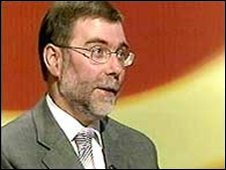
Nelson McCausland has said he will not attend a Catholic Church service
However, Presbyterian Moderator, Dr Stafford Carson, said he would not have problem attending a Catholic service.
Speaking on Radio Ulster's Sunday Sequence programme, Dr Carson said: "I think very often personal and human connections take us into those kind of situations.
"I don't think we'll want to cause offence or hurt in any way and a minister attending a service like that does not necessarily mean that he would endorse all that that denomination believes."
Dr Carson said it was for the minister himself to decide but explained that "very often people, on the occasion of a funeral or a bereavement or something, believe that it is important to identify with the people rather than with the theology".
'Religious liberty'
In an Assembly debate on Monday, Sinn Fein said Mr McCausland's refusal to attend a Catholic church service had "no place in an inclusive society" and said that it was his ministerial duty "to serve, respect and engage with all sections of society regardless of their religious background".
Mr McCausland said he would attend a "cultural or community event in a Roman Catholic building" in his role as minister and pointed out he had already attended a concert by the Ulster Youth Choir at Clonard monastery in west Belfast.
He said his issue was "one solely of worship" and argued that Sinn Fein was trying to deny him his basic human right of "religious liberty and freedom of conscience".
http://www.belfasttelegraph.co.uk/news/politics/britains-role-in-treatment-of-terror-suspect-to-be-revealed-14534855.html
Secret evidence about the alleged torture of a UK resident captured by the Americans must be made public, the High Court ruled yesterday in a judgment that raises serious questions about what Britain really knew of its ally's interrogation practices.
The case, concerning the treatment of Binyam Mohamed, 31, when he was held under US authority in Pakistan and Morocco, has serious implications about the legality of Britain's role in the "war on terror". The court has held it was clear from the fact that the UK intelligence services sought to interview Mr Mohamed during his detention and supplied information and questions for his interviews by others "that the relationship of the United Kingdom Government to the United States authorities in connection with Binyam Mohamed was far beyond that of a bystander or witness to the alleged wrongdoing".
The ruling related to the court's previous judgment on Mr Mohamed's claims of torture, which contained seven redacted – or blanked-out – paragraphs. The Independent, and other media, were seeking to have these paragraphs made public.
The Foreign Secretary had claimed that the Americans had threatened to withdraw intelligence co-operation if the material was released.
But yesterday Lord Justice Thomas and Mr Justice Lloyd Jones said they could not accept his evidence that the Obama administration was adopting the same stance as the Bush government. And they could not accept there was anything in the redacted paragraphs that would have prejudiced intelligence-sharing relations.
"As the risk to national security, judged objectively on the evidence, is not a serious one, we should restore the redacted paragraphs to our first judgment," they said.
Mr Mohamed was still being held at Guantanamo Bay awaiting trial at the time of the court's original judgment in August last year, but has since been released and has returned to the UK.
The Foreign Secretary, David Miliband, said he would appeal against the ruling that the US intelligence material on Mr Mohamed should be made public.
Mr Miliband said the Government was "deeply disappointed" by the judgment. The Foreign Secretary warned that the US may no longer be willing to share intelligence if it feared that it might later be disclosed on the orders of a foreign court.
In a statement, he said: "The Government is deeply disappointed by the judgment handed down today by the High Court which concludes that a summary of US intelligence material should be put into the public domain against their wishes. We will be appealing in the strongest possible terms."
Mr Miliband's statement follows comments from the head of MI5, who defended co-operation with countries accused of using torture, insisting it helped prevent many terrorist attacks on British soil.
peaking for the first time about his organisation's alleged complicity with countries engaged in abuse, Jonathan Evans said the issue had presented "a real dilemma" but it would have been a "dereliction of duty" not to get intelligence on al-Qa'ida and other Islamist groups.
Mr Evans' acknowledgement of the controversial links with foreign intelligence agencies comes at a time when MI5 is facing a series of legal claims from victims of mistreatment as well as an unprecedented investigation by Scotland Yard.
The director-general of MI5 maintained that while he could not comment on specific allegations it was "a very clear and long established principle" that MI5 did not collude in torture or solicit others to torture on its behalf.
However speaking at his old university, Bristol, in a speech commemorating the 100th anniversary of MI5, Mr Evans said action taken in the aftermath of the 9/11 terror attacks had to been seen in the context of the times, when the UK and other Western countries were faced with a terrorist threat that was "indiscriminate, global and massive".
http://www.belfasttelegraph.co.uk/news/local-national/northern-ireland-angler-survives-crocodile-attack-14531036.html
An angler from Northern Ireland has survived a crocodile attack to land a giant fish while on holiday in Africa.
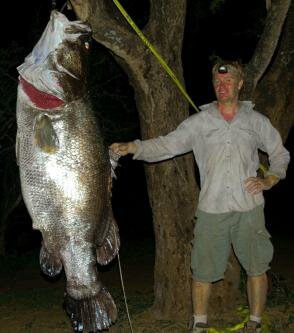
Tim Smith came within inches of being snapped up by the mighty predator as he battled the 249lb Nile perch on the end of his line.
Fermanagh angler Tim Smith with a prize Nile Perch
Back safely behind his desk at Portora Royal School in Enniskillen this week the 39-year-old art teacher has been recalling the moment the fish and the crocodile struck.
Tim was fishing from a small boat on the Victoria Nile in Uganda, about a mile downstream from the stunning Murchison Falls, when the huge perch grabbed his bait.
“For the next 45 minutes this fish took me up and down the river,” he said.
All that commotion seems to have attracted the attention of the crocodile, which Tim glimpsed out of the corner of his eye.
“Suddenly the boat lurched and I nearly fell out,” he recalls.
“I didn’t really know what had happened.”
He was standing at the back of the boat beside the engine with his feet wedged against the stern, straining into the fish.
“The next thing is, the crocodile launches itself at me, mouth wide open,” said Tim.
Fortunately for him it had misjudged its jump and fell short, hitting the side of the boat.
“If it had launched itself another foot I’m sure it would have got hold of me,” he admitted.
“It obviously hit the front of the boat to try and knock me out and then went to the other side. This thing was attacking the boat.”
“When you realise something that size is trying to eat you it’s really quite daunting. I just fell back into the centre of the boat, still holding the rod.”
Almost 45 minutes had elapsed and fish was now exhausted and lying flat on the surface of the water just a few yards from the boat.
“I just saw the crocodile swim up and grab the fish’s tail and spin it around in a death roll but because of the size of the fish it couldn’t get a proper grip,” said Tim.
The Nile perch made one final dive to get away from the crocodile and Tim was able to get close enough to the fish to grab it and tie it to the side of the boat.
Tim said: “I pulled up the anchor as fast as I could. By the time I got the engine started the crocodile was just coming around. I slammed into gear and the croc dived and disappeared.”
He drifted down the river for about half a mile and tied the fish to a tree and went to a nearby wildlife safari lodge to get help.
http://www.guardian.co.uk/uk/2009/oct/12/lockerbie-bombing-abdelbaset-al-megrahi
David Miliband has revealed that the UK government supported the decision to free the man convicted of the Lockerbie bombing because his death in a Scottish jail would have damaged trade and diplomatic ties to Libya.
The foreign secretary disclosed that Libya and Scottish National party ministers were told in advance that the government agreed "as a matter of policy" that Abdelbaset al-Megrahi should be freed on compassionate grounds because of his terminal cancer.
His remarks, made in a statement on the Megrahi affair to MPs on their first day back after the recess, confirm that the government had formally sanctioned the release by making its views known to both sides.
Miliband insisted that UK ministers had no power or desire to pressurise the Scottish justice secretary, Kenny MacAskill, to release Megrahi because that was solely a matter for the Scottish legal system.
But he would make "no apology" for protecting business links with Libya, British jobs and the government's efforts to win Libyan help on security and counter-terrorism, including tackling al-Qaida terrorists in north Africa who killed the British tourist Edwin Dwyer in May.
"There is an entirely legitimate commercial dimension to our ties. With the largest proven oil reserves in African and extensive gas reserves, Libya is potentially a major energy source in the future," he said.
"British interests, including those of UK nationals, British businesses and possibly security co-operation would be damaged, perhaps badly, if Megrahi were to die in a Scottish prison rather than Libya," he told the Commons.
"Given the risk of Libyan adverse reaction, we made it clear to them both that as a matter of law and practice it was not a decision for the UK government, and as a matter of policy we were not seeking Megrahi's death in Scottish custody."
Even though Libya had renounced weapons of mass destruction and support for terrorism, the UK was still pressing for Libya to settle two outstanding disputes, he said, over the unsolved murder of WPC Yvonne Fletcher in 1984 and the growing demands for compensation for the victims of IRA terrorist attacks backed by Libya.
Ministers continued to seek Libya's co-operation on the Metropolitan police investigation into Fletcher's death outside the Libyan embassy. The Foreign Office was also arranging a visit to Tripoli for the families of IRA victims and MPs to seek a deal on "humanitarian" grounds.
But Miliband's attempts to settle the controversy surrounding Megrahi's release were rebuffed by senior Tories, the Liberal Democrats and some Labour backbenchers, who accused the government of seriously damaging relations with the US and betraying the 270 victims of the atrocity.
William Hague, the shadow foreign secretary, said the government's handling of the affair had been "characterised by confusion and obfuscation". Gordon Brown's refusal to make a statement on whether he agreed with Megrahi's release for nine days was "deeply regrettable", he said. Even after the prime minister had said he respected the Scottish government's decision, there was further confusion after the children's secretary, Ed Balls, claimed that "no one" wanted Megrahi to be released.
This had damaged the UK's relations with the US because it left a "cloud of suspicion" over all its dealings with Colonel Muammar Gaddafi's regime, Hague said, repeating his call for an independent inquiry into the controversy.
Although ministers were right to help Libya renounce terrorism and to improve trade, "the case to release Megrahi against that background was outweighed by the requirements of justice and the fact that he had been sentenced to life imprisonment for the murder of 270 people", Hague said.
Ed Davey, the Lib Dem foreign affairs spokesman, repeated his demand for an independent inquiry, and said it was now clear that "trade came before justice".
http://www.cnn.com/2009/WORLD/europe/09/06/uk.libya.ira/index.html
Brown, right, will support asking Gadhafi's Libyan regime to pay compensation to IRA bomb victims.
LONDON, England (CNN) -- British Prime Minister Gordon Brown announced Sunday that his government will support IRA victims in seeking compensation from Libya, in a move conservatives called a "U-turn" from his earlier position.
"I desperately care about what has happened to those people who have been victims of IRA terrorism," Brown said at a Sunday news conference in Germany.
"We will appoint dedicated officers in the Foreign Office and our embassy in Tripoli [who] will accompany the families' representatives to meetings with the Libyan government to negotiate compensation," he added. "And the first of these meetings is being held in the next few weeks."
Libya is accused of supplying explosives to the IRA for terrorist attacks.
Previously secret documents released Sunday by Brown's office show that the prime minister had argued, "Libya has made it clear to us that they consider this matter closed."
In the letters written to Jason McCue, an attorney representing victims of bombings by the Irish Republican Army, Brown also argued that pushing Libya "would entail substantial risks." British media highlighted a section in which Brown wrote that it would "not be appropriate" to have direct talks with Libya on the matter.
In the letters, Brown denied being reluctant to anger Libya for fear Britain would lose out on oil deals -- an allegation made by the Sunday Times newspaper and by McCue.
In the two letters, written in September and October, Brown cited Libya's about-face on terrorism as the key factor.
Facing outrage in Britain over the issue, Brown said Sunday, "I desperately care about what has happened to those people who have been victims of IRA terrorism."
Speaking in Berlin, Germany, with German Chancellor Angela Merkel, Brown said he would provide Foreign Office staff to assist the IRA attack victims when they travel to Libya in the next few weeks to seek direct talks with Libyan leader, Col. Moammar Gadhafi.
Successive governments have raised the issue of Libyan support for the IRA, Brown said, but the British government determined the most effective means of seeking victims' compensation was through supporting families in their legal battle, not through direct negotiations with Libya.
A foreign affairs spokesman for Britain's opposition Conservative Party said in a statement that Brown's comments were "a stunning admission that the government has failed to support the families of the victims of IRA terrorism in their pursuit of compensation from Libya."
"This U-turn comes only after today's reports that Gordon Brown was personally involved in a decision not to engage Libya on the issue," said William Hague in the statement. "The British government should have provided active support as a matter of course, not as a result of public pressure."
On Saturday, a top government minister said oil and trade were considered at one point as factors in the release of the Lockerbie bomber.
And Gadhafi's son, who was involved in negotiating accords between the two nations, told CNN that Libya pressed the British government to include the convicted terrorist in a 2007 prisoner release agreement that was tied to trade deals.
Ultimately, convicted bomber Abdelbeset Ali Mohmed al Megrahi was released on compassionate grounds because he is dying of cancer, a decision that Scottish, British and Libyan officials have said was not linked to oil or trade.
In an interview published Saturday in The Daily Telegraph, British Justice Secretary Jack Straw said trade and the interests of oil giant BP were factors in the prisoner transfer agreement.
"Yes, (it was) a very big part of that," Straw told the paper. "I'm unapologetic about that. ... Libya was a rogue state. We wanted to bring it back into the fold. And yes, that included trade because trade is an essential part of it and subsequently there was the BP deal."
Straw's adviser said Saturday that Straw's quotes were accurate, but he emphasized that al Megrahi was not released under the terms of that deal.
Scottish Justice Secretary Kenny MacAskill decided last month to release al Megrahi, who was serving a life sentence for the 1988 bombing of Pan Am flight 103 over Lockerbie, Scotland.
The bombing killed 270 people and was the world's deadliest act of terrorism until the September 11, 2001, attacks on the United States, according to the FBI.
Brown insisted Wednesday that there was no secret arrangement to release al Megrahi in exchange for oil deals.
"On our part, there was no conspiracy, no cover-up, no double-dealing, no deal on oil, no attempt to instruct Scottish ministers, no private assurances by me to (Moammar) Gadhafi," he said.
Gadhafi's son Saif al-Islam Gadhafi accompanied al Megrahi back to Libya last month.
"The decision was based on compassionate grounds, not because of business deals," Gadhafi said. "It was obvious. The guy is sick, seriously sick. He has cancer and because of that they made the decision and I think it was the right decision."
http://www.guardian.co.uk/commentisfree/2009/sep/08/libya-ira-compensation-gerry-adams
If Britain is backing compensation from Libya for victims of IRA bombs, it should pay for those harmed by its unionist proxies
The demand for compensation from the Libyan government for victims of IRA actions, in which it is claimed Libyan armaments were used, and the British government's role in this, is the cause of some controversy in Belfast. On Monday, I spoke to Downing Street and to Northern Ireland secretary Shaun Woodward about this. I told them there could be no hierarchy of victims; that all victims deserve compensation – and that Mr Brown's position is totally inconsistent.
I support compensation for all victims. But this has to include the victims of British state violence and collusion.
No one should be surprised by the hypocritical stance of successive British governments on this issue. The role of the British state in killing citizens in Ireland in recent times is well-documented. Apart from killings by state forces, British intelligence agencies also armed unionist paramilitaries, including Ulster Resistance, which was established by the DUP, and provided the information which led to countless deaths.
The tactics employed in collusion were drawn from decades of British experience in fighting colonial wars elsewhere. But it was the work of Brigadier (later General Sir) Frank Kitson that refined its use in Ireland. Kitson was the British Army's foremost expert on counterinsurgency. He rationalised the use of death squads and the corruption of justice:
Everything done by a government and its agents in combating insurgency must be legitimate. But this does not mean that the government must work within exactly the same set of laws during an emergency as existed beforehand. The law should be used as just another weapon in the government's arsenal, in which case it becomes little more than a propaganda cover for the disposal of unwanted members of the public.
In the early 1970s, the British killed Catholics and Protestants and carried out actions, including bombings, using surrogate groups. The UDA, which remained a legal organisation for almost 20 years, and the UVF, carried out a campaign of killings against Catholics. They were supplied with information by the British intelligence agencies, including files, photographs and details of cars and movements.
One of the first people to be recruited by British intelligence was the loyalist Brian Nelson, a former British soldier. In the summer of 1985, Nelson was sent to apartheid South Africa to get weapons. To finance the trip, the UDA, UVF and Ulster Resistance carried out a bank robbery at the Northern Bank in Portadown; this netted £325,000, which was then used to purchase a shipment of arms consisting of 200 AK47 rifles, 90 Browning pistols, 500 fragmentation grenades, ammunition and 12 RPG launchers.
In the three years after the South African shipment, unionist paramilitaries killed 224 citizens and wounded countless scores more. One of these was Pat Finucane, a human rights lawyer, who was shot dead in February 1989 at his home in north Belfast.
In dealing with the issues of truth and victims, all of these matters must be open to scrutiny. I have no problem with campaigns for governments to pay compensation. But that has to include the British government.
Gordon Brown's position is totally inconsistent, but this is in keeping with London's longstanding game-playing on this important matter. Another example of this is to be found in Shaun Woodward's recent dismissal of the Eames/Bradley Commission proposal for an acknowledgment payment to all victims.
The fact is the British government is a player in all of these issues. It was one of the combatants in the conflict and is not and cannot be, or pretend to be, an objective or neutral referee.
Updated: 11/5/2009


Use the Guest Book to Comment on the web site or individual stories.
To get Irish News updates emailed to you