Irish Northern Aid
News
 |
||||
Saturday, October 31, 2009
By Dennis B. Roddy, Pittsburgh Post-Gazette
Two women from different nations that share the same place spoke last night about how to guarantee an end to centuries of strife in Northern Ireland.
Rita O'Hare, general secretary of Sinn Fein, and Dawn Purvis, head of the Progressive Unionist Party, spoke last night at the University of Pittsburgh, where they traded views on how to bring two bitterly divided people together in the six counties of Ireland that remain a part of Great Britain.
"Not all that long ago, we would not have been able to share a platform together, as much as we might have wanted to," said Ms. O'Hare, who advocates folding Northern Ireland into the adjacent Republic of Ireland.
Ms. Purvis, a generation younger than Ms. O'Hare, grew up without knowing any Catholics or Irish republicans. She remains committed to keeping Northern Ireland British and described herself as "a child of the Troubles."
The forum was co-sponsored by the Ireland Institute of Pittsburgh and the Pitt's Center for International Study.
Northern Ireland's republicans -- so called because they seek a unified Republic of Ireland -- are overwhelmingly Catholic. The unionists, so called because they want to retain union with Great Britain, are overwhelmingly Protestant. Religion and politics have often remained conflated in the armed struggle, further deepening divisions and sometimes exploited by politicians on both sides.
That the two women were at the same table was remarkable in itself and testimony to the extraordinary movement toward peace that has since followed cease-fires by both the IRA and pro-British paramilitaries on the unionist side.
Ms. O'Hare's party, Sinn Fein, served as the political wing of the IRA. Ms. Purvis's party, the PUP, was the political arm of the Ulster Volunteer Force, founded by former paramilitary David Ervine.
Both women came praising the United States for its role in brokering the Good Friday Agreement that largely ended violence in Northern Ireland.
The armed portion of that struggle, which stretches through British and Irish history, flickered throughout the centuries and reignited in the North in 1968, when the Catholic minority sought full civil rights. After more than 3,000 deaths in a region with less than 2 million people and an armed occupation by the British military, the Troubles began to subside with cease-fires by both the IRA and the Loyalist paramilitaries.
An overarching political settlement has remained elusive in the 15 years since the peace process began.
"There's a lot of problems on both sides. There's hardliners on the Republican movement, and there are hardliners within the unionist movement," said Tony Novosel, a Pitt professor regarded as one of the leading American experts on Northern Irish politics and the unionist movement. "The goal is to transform it into a long-term peaceful society in which both traditions can get along," he said.
One of the great ironies of the peace process, both women agreed in interviews, was the common ground between loyalist and republican families once the issue of national identity was out of the equation.
Ms. Purvis viewed that as a legacy of Mr. Ervine, who died two years ago. "People in the unionist community needed to wake up and realize that Northern Ireland was a bloody awful place," she recalled him saying.
In government, Sinn Fein and the PUP have found common ground on a number of social welfare issues in the working-class areas each side represents. "That is one of the wonderful transformations that the peace process has brought," Ms. O'Hare said. "We have common purpose in some areas."
Still, not every transformation appeared welcome last night.
The question of Irish unification remains a clear line of demarcation between the two party figures, evident in the flat answers given to a question from the audience: Would most people in the adjacent Republic of Ireland welcome a return of the north?
Replied Ms. Purvis: "In a word? No."
The question turned to Ms. O'Hare.
"In a word? Yes," she replied.
http://www.irishcentral.com/news/ILIR-and-AOH-meet-Lindsey-Graham-in-push-for-immigration-reform-66907717.html
THE promise of immigration reform benefiting the undocumented Irish in America took a quiet but very important step forward in Washington, D.C. last week with a pivotal meeting between Republican Senator Lindsey Graham of South Carolina, Ciaran Staunton, president of the Irish Lobby for Immigration Reform (ILIR) and South Carolina Ancient Order of Hibernians board member Jim Lawracy.
The meeting, also attended by ILIR consultant Bruce Morrison, discussed immigration reform proposals and their impact on the Irish American community.
Graham was very interested to learn of the Irish dimension to the immigration reform debate and urged Irish and Irish American leaders to continue to make their voices heard on the issue.
Graham, the senior senator from South Carolina and an influential member of the Senate Judiciary Committee, has again called for the passage of comprehensive immigration reform and was a supporter of the McCain-Kennedy bill of 2006, as well as the ultimately unsuccessful comprehensive immigration reform Act of 2007.
Last week’s meeting was part of the ILIR effort to demonstrate the Irish dimension in the broader immigration issue to key policy makers across the U.S. on a state by state and bipartisan basis.
Graham was unambiguous in saying that he supported both legalization for the undocumented and a targeted program for future flows from Ireland modeled on the E-3 proposal as part of comprehensive legislation.
He underscored the positive contribution that advocacy by the Irish played for him in showing people in South Carolina that this issue is not just about one ethnic group. He noted that 40% of the undocumented arrived on visas or visa waivers and overstayed.
http://www.belfasttelegraph.co.uk/news/local-national/republicans-angry-over-payment-offer-to-former-policemen-14546211.html
Friday, 30 October 2009
The Government was today accused of agreeing to pay former part-time police officers in Northern Ireland £20 million in a bid to secure political concessions from the Democratic Unionist Party (DUP).
Sinn Fein today produced a letter sent by Prime Minister Gordon Brown to DUP leader and Northern Ireland First Minister Peter Robinson making the multi-million pound offer.
Republicans claimed it was a bid to "buy-off" DUP support for the devolution of policing and justice powers from Westminster to Stormont and claimed government risked bringing the process into disrepute.
Sinn Fein and the DUP have been locked in talks with Mr Brown on efforts to transfer the powers that would effectively see unionists and republicans share responsibility for Northern Ireland's police and justice system for the first time.
"Yesterday I was given a letter from Gordon Brown to Peter Robinson indicating that the British government has decided to issue a gratuity payment of £20 million to former members of the RUC Part Time Reserve," said Sinn Fein Junior Minister Gerry Kelly.
"When Gordon Brown raised this issue with ourselves, Martin McGuinness told him that such a payment was wrong and unacceptable and was no part of the process to transfer powers on policing and justice."
The dispute over the devolution of the powers has threatened the stability of the power-sharing government at Stormont.
And while Sinn Fein has pressed for swift action on the transfer of powers, the DUP has said it wants to proceed with caution to ensure the process is properly stewarded.
The main unionist party, however, also faces pressure from hard-liners who are opposed to a deal which would give republicans any role in overseeing police and the courts.
Mr Brown has offered the parties a financial package estimated to be worth more than £800million to fund the devolution process, but while Sinn Fein has accepted his offer, the DUP has yet to do so.
Democratic Unionist leader Mr Robinson has called for the scrapping of the Parades Commission to help ease tension over marches ahead of the devolution of powers into the hands of local politicians.
Nationalists have, however, accused the DUP of trying to secure the scrapping of the commission for political reasons. The Parades Commission has restricted Orange Order parades in Catholic areas and its removal has been a long-standing demand of unionists.
Mr Kelly said the Prime Minister had previously sent a separate letter confirming his near £1billion funding package for devolution.
But he said the latest offer of funds for former Royal Ulster Constabulary part-time officers, understood to have missed out on earlier financial packages to former members of the force, was not included.
"The detail of the financial package agreed with the British Government between Martin McGuinness and Peter Robinson is set out in the letter from Gordon Brown to the parties," said Mr Kelly.
"This (further) payment forms no part of it. The effort to transfer policing and justice powers is being brought into disrepute by the British government's willingness to buy off the DUP.
"At a time of economic downturn, and huge pressures on working families and the disadvantaged this payment is a waste of taxpayers' money.
"It should also be remembered that this is the same British government which in the wake of the Eames/Bradley report quickly moved to veto a recognition payment to those bereaved through the course of the conflict."
Mr Kelly claimed the letter from Mr Brown to Mr Robinson was sent, apparently mistakenly, to the Office of First Minister and Deputy First Minister at Stormont.
This meant it was automatically copied to Sinn Fein's Martin McGuinness, who under the rules of the power-sharing government, shares the top political office with Mr Robinson.
http://sport.scotsman.com/football/Tom-English-39The-selfpitying-.5784490.jp
Published Date: 01 November 2009
ANDY GORAM is a hard man to ignore, but it's really worth the effort. There is no getting away from him these days. He's on the telly and he's on the radio, he's in the papers waxing about Walter Smith and Sir David Murray and the Lloyds Banking Group and at every turn he has a captive audience of journalists and photographers and people who are more than happy to tell him that his views are worth listening to.
Soon he's going to be guest of honour at a benefit dinner in Glasgow. No doubt, a legion of past Ibrox heroes will be there to celebrate his life and times. Unquestionably, there will be hordes of supporters on hand to chant his name and listen to his patter.
Goram's book is coming out this week. You may have read some of it already in the Sun. The drinking, the shagging, the betrayal of one wife and then another and then another – it's all there. The truth according to Goram. The self-pitying tone of the published extracts tells us that the former Rangers goalkeeper still sees himself as something of a victim.
The walkout before the World Cup in 1998 is depicted, not for the first time, as all Craig Brown's fault. Goram's bitterness towards his former manager is acute. he will never forgive him for what he did back then. He was outraged and disgusted at losing his place to Jim Leighton. The angst he will take with him to the grave. And so on.
Of course, at the time Goram said little of this. In 1998, the story went that he'd left the squad because of constant tabloid interference in his private life. That was what he said in an official statement upon leaving the team base. One tabloid in particular seemed to be the chief source of his anger – ironically, it was the Sun. Only a few days before his disappearing act, the tabloid ran a wounding story about an alleged affair Goram had had with a woman who worked for Celtic. "It is plain to see," said the goalkeeper by way of a press release, "that stories are being fabricated to upset me or our World Cup preparations. Myself, Craig Brown and the players don't need this. The last thing the squad needs is controversy off the park."
History seems to have been rewritten in this instance. His story, though. And his truth.
Quite honestly, the bonk-fests and the blubbering about all the mistakes he made when polluted by drink are tedious. We've heard them all from him before. What is interesting is the stench of sectarianism that still hangs over him and the fact that, despite some controversial incidents in his past, his benefit dinner still seems to have the imprimatur of his old employers at Ibrox. Remember, it is barely a year since Goram, when opening a pub, spoke of an altercation with Pierre van Hooijdonk in an Old Firm match in 1996. He told a cheering group of Rangers fans that when he saved the Dutchman's penalty in that game he went up to him and called him – and he was paraphrasing here – "a non-white, unclean, non-Protestant with no father". And Goram is going to be lauded at a benefit dinner?
But back to the book. There is one aspect of his life that has a grisly fascination and that is his supposed links with loyalist terrorists in Northern Ireland. He recounts a story about him drinking in the Rex bar on the Shankill Road in west Belfast. The Rex was not a political pub but still it was a favourite haunt of Ulster Volunteer Force supporters. This is where Goram fetched-up.
He says he was reading a book about the Shankill Butchers at the time, the notorious gang of loyalists who specialised in torture and murder by throat-slashing in the 1970s.
"I was told someone wanted to meet me," writes Goram. "When I got up there, the man in question was a huge lad, and he said 'Pleased to meet you, Goalie. I'm Big Sam (McAllister], the Shankill Butcher'. My mind a blank, despite what I had just heard, I said, 'All the best. How is your shop going?'"Goram tells us that he had a creeping realisation that maybe Big Sam wasn't going to be giving him free sausages and that, in fact, he was one of the most vicious killers The Troubles had ever known. "The sweat formed on my top lip, and we chatted amiably enough until I sidled back downstairs. So, yes, I've met men deeply involved with the UVF and been in their company on fleeting occasions. But terrorist sympathiser? No."
No? What about Billy Wright, then? We all remember Goram and Wright, aka King Rat, aka leader of the extremist Loyalist Volunteer Force until the Irish National Liberation Army murdered him in the Maze prison in 1997. Goram and Wright met on a flight to Belfast. Goram claimed he hadn't a clue who he was until somebody told him. Police pulled Goram in for questioning about his contact with Wright.
As he says in his book: "Rumours and innuendo started to paint a picture of me: Andy Goram, hard-drinking, hell-raising bigot, friend of the UVF. I'd unwittingly add to that perception by wearing a black armband in a match against Celtic soon after Billy Wright was shot three times and killed by an Irish National Liberation Army assassination squad inside the Maze prison."
Ah yes, the armband. Worn at an Old Firm match five days after Wright was killed. Goram claimed he was wearing it for his aunt Lilly, who died four months earlier. Goram says he loved Lilly dearly, which begs the question: Why did he wait four months to pay tribute to her?
His explanation for his association with terrorists in the past are weak. The armband defence remains risible. The account of his meetings with Wright and Big Sam should trouble those who are about to pay tribute to Goram at the benefit night. The abuse of Van Hooijdonk, I'm guessing, doesn't get a mention anywhere in the book.
His supporters will say that they are going to celebrate the goalkeeper but in this case you cannot separate the goalie from the man. And the man has left many, many unanswered questions about aspects of his life
http://www.irishnews.com/articles/540/5860/2009/10/27/631051_398225363602Hasbigotr.html
SECTARIANISM, it appears, can reach beyond the grave. A Belfast family believe the ghost of a controversial Unionist politician, who died more than 60 years ago, may be haunting them – because they are Catholic.
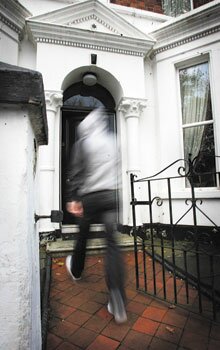
unwelcome guest: the north Belfast home of the Fitzpatrick family which they believe is being haunted by the ghost of a Unionist politician Richard Dawson Bates, ‘demonologist’ Lorraine Warren who is most famous for her links with the Amityville mystery in the US is helping the Belfast family evict their unwelcome guest
The Fitzpatricks, from the north of the city, have noticed strange goings-on in the home they say was once owned by Richard Dawson Bates, the first minister of home affairs in the wake of partition.
So concerned are they about mysterious smells, sounds and sights that they have enlisted the help of a famous American ghost hunter to investigate the house next month.
They say deeds prove Dawson Bates lived in the Victorian property off the Antrim Road for around three decades from the early 1900s.
He was involved with the UVF during the anti-Home Rule campaign of 1912-1914 before becoming a minister in the new Northern Ireland government in 1921.
GC Duggan, a former northern comptroller and auditor-general, once said Dawson Bates had “such a prejudice against Catholics that he made it clear to his permanent secretary that he did not want his most juvenile clerk or typist, if a Papist, assigned for duty to his ministry”.
Maria Fitzpatrick and her twin sons Nathan and Carl (22) say they first began noticing unexplained happenings around five years ago after one of them brought a ouija board into the house.
As well as seeing human-shaped figures, hearing breathing in empty rooms and the sound of human wailing, they also claim to have smelt tobacco smoke.
“I saw in the deeds that Richard Dawson Bates had lived in this house for around 30 to 40 years,” Nathan said.
“He was an absolute bigot and he hated Catholics with a passion. He was a chain smoker and we’ve all smelt smoke in this house even though none of us smoke.
“I was wondering is it him? Because we’re the first Catholic family ever to have lived in this house.”
The family, who asked for the full address of the house to be withheld, also fear there is a female ghost in the house. Mrs Fitzpatrick claims to have seen her face at an upstairs window in the dead of night.
Carl is more sceptical about the apparent supernatural activity.
“Things have happened to me and I’ve always convinced myself that there is obviously a reason for this,” he said.
“But I haven’t been able to find an explanation yet.”
Lorraine Warren, a ‘demonologist’ who became famous for investigating the Amityville murders in America, is to investigate the claims when she comes to Belfast for an event in the Hilton hotel on November 19.
“When they said about smoke – that is one type of infestation that is quite common – smells of perfume or tobacco,” the investigator who has appeared on Living TV’s Paranormal State said.
“I first worked with this family five years ago and, after some advice I gave them, it all stopped. But it has started again so I’m going to see what is needed.
“I hope this man is not going to hold it against me for coming over because I’m a Roman Catholic too.”
Updated: 11/5/2009


Use the Guest Book to Comment on the web site or individual stories.
To get Irish News updates emailed to you