Irish Northern Aid
News

 |
||||
http://www.anphoblacht.com/news/detail/38976
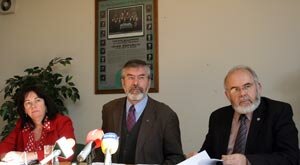
THE Legacy Commission suggested by the Eames/Bradley Group (Consultative Group on the Past) does not meet republicans’ call for an Independent International Truth Commission, Sinn Féin President Gerry Adams declared on Wednesday.
The West Belfast MP was launching Sinn Féin’s proposals on truth recovery at a Belfast press conference with victims spokesperson Francie Molloy MLA and West Belfast MLA Jennifer McCann.
Speaking at the press conference, Gerry Adams said that he would call on republicans to participate and play a full role in an Independent International Truth Commission.
“Sinn Féin have long called for the establishment of an Independent International Truth Commission to deal with the causes and consequences of the conflict. We repeat that call today. The proposed ‘Legacy Commission’ is not an independent international truth recovery process.
“For a truth recovery process to be successful and to deliver for bereaved families and survivors it needs to have maximum participation.
“I would call on republicans to participate and play a full role in an Independent International Truth Commission.
“It needs to have the confidence of the community. It needs to be independent of the state, combatant groups, political parties, civil society and economic interests. It needs to examine both the causes and consequences of the conflict.
“The two governments should authorise a reputable body such as the United Nations to devise and implement a process which will guarantee independence and ensure confidence and participation in any future truth commission.”
The Sinn Féin document launched on Wednesday is, he said, “a genuine attempt to address this issue in a thoughtful and comprehensive way”.
It contains a number of recommendations and commentary on proposals already put forward by the Eames/Bradley Consultative Group on the Past.
The document insists:
“An effective truth recovery process is dependent on full co-operation by all relevant parties.”
Sinn Féin also stressed that “the body charged with this onerous task should have a remit to inquire into the extent and patterns of past violations as well as their causes and consequences”, including what it called “the tragic human consequences” of the conflict.
Sinn Féin added:
“This body should also examine and report on institutional and collective responsibility, and must be independent of the state, combatant groups, political parties, civil society and economic interests.
“In the above context, the two governments should authorise a reputable body, such as the United Nations, to devise and implement all measures and processes necessary to achieve this.”
These would include:–
• The independence of the commission;
• Effective independent truth recovery methods; and
• The public reporting of its findings, conclusions and recommendations.
“This should be underpinned in legislation,” states the Sinn Féin submission.
At the launch of the submission, Sinn Féin President Gerry Adams outlined his view that the Sinn Féin proposals were the best way to take this forward.
“We reject all attempts to create and sustain a hierarchy of victims.
“All processes should be victim-centered and should deal with all victims of the conflict on the basis of equality.
“There are vested interests who do not want the truth and who will oppose the creation of a meaningful truth recovery process and who will use specious ‘political legitimacy’ issues to that end. The disgraceful British and unionist wrangle over the ‘definition of a victim’ and the ‘recognition payment’ are cases in point.”
Adams went on to say:
“Truth recovery cannot and will not be dealt with through a British or unionist prism or, for that matter, through an Irish republican prism.
“The British Government, which has historically played such a divisive and violent role in Irish affairs, must join in an honest endeavour which allows the people of our island to carve out a new future.
“The British Government has pursued, as a matter of policy, the use of administrative and institutional violence and collusion.
“It has employed the full weight of its political influence and authority to actively deny, cover up and block truth recovery processes.
“This has involved the suppression of reports by various commissions from Stalker to Sampson, to Stevens, and has also refused to fulfil its commitments, for example, on the Pat Finucane murder case or its refusal to co-operate with the Barron Commission on the Dublin/Monaghan bombings.
“If there is to be an inclusive healing process and a genuine process of reconciliation, then the British Government must face up to its responsibilities.
“The Irish Government has a constitutional, legal and moral responsibility to actively promote and encourage this course of action.
“All of us have to pledge ourselves to tell and hear the truth about the past.
“Building a united, harmonious society demands that all the difficult issues are dealt with in an equal and inclusive way and as a necessary part of putting the past behind us.
“Looking after victims’ families and survivors is a significant and important part of this.”
http://www.herald.ie/national-news/leaving-belfast-was-like-the-end-of-a-love-affair--holy-cross-priest-1910276.html
By Andrew Phelan
Saturday October 10 2009
FR Aidan Troy, the priest caught in the middle of a loyalist protest at Belfast's Holy Cross School, has said leaving the Ardoyne was like the end of a love affair.
The cleric, who came to international prominence during the demonstrations eight years ago, has compared his move from the community to a bereavement. Despite getting death threats during the fraught three-month protest, Fr Troy has told how difficult it was for him to say goodbye.
In a frank radio documentary to be broadcast on RTE this weekend, he speaks of the "emptiness" he felt after his transfer last year to an affluent Paris suburb.
Fr Troy took up his new office at Saint Joseph's Church on leafy Avenue Hoche, in the shadow of the Eiffel Tower, in September 2008.
This followed a seven-year term in Belfast, where his ministry in Ardoyne had spanned both the Holy Cross protest walks in 2001 and the blight of suicides beginning in 2003.
After Belfast, Kaye Morley's documentary on RTE Radio 1 on Saturday, gives an indepth account of Father Troy's life.
Of the Holy Cross protest walk, he says: "Once I was asked by the parents on the first morning, 'Will you walk with us? You might be our insurance to save the lives of our children.' Once I walked one step on that road I was entirely committed to being the last step off that road.
"I still see the faces of the children going to school. I will never forget the looks of absolute terror ... When you went up the road you'd never know on two consecutive mornings what you were going to find."
Fr Troy describes being abused and spat at every day.
"There were posters saying 'Fr Troy is a paedophile'. There were the most horrendous pornographic pictures held out to the children ... There was constant intimidation in the way of conversation, screaming, shouting, placards."
Although he found his work tough in Belfast, he freely admits that he would not have chosen to move to Paris. Leaving Belfast was like a bereavement for him, he said, because it involved not just leaving people, but also a type of immediacy of social engagement which he had discovered there.
"It was like falling in love and then being told that the affair is over and it was that sort of feeling -- I don't want it to be over. I think I fell in love with engagement at a human level," he says.
Leaving Belfast is broadcast at 6.05pm on RTE Radio 1 on Saturday
http://news.bbc.co.uk/2/hi/uk_news/northern_ireland/8298202.stm
Northern Ireland's first and deputy first ministers are to brief their parties following further talks on the devolution of policing and justice.
Following late night discussions in Downing Street on Thursday, Sinn Fein's Martin McGuinness said "massive progress" had been made.
He said all sides were "on the cusp of agreement" on a financial package to fund the transfer of the powers.
The DUP's Peter Robinson said he would respond after speaking to his party.
But he said recent negotiations with the prime minister had won "millions of pounds" more for the policing and justice budget.
On Friday, he said that before putting the latest figures to his party he wanted to make sure that the police and the court service had all they needed.
Mr Robinson said he was right in not coming to a deal too quickly.
"We are hundreds of millions of pounds better off in our police and justice budget today than we were in New York," he said.
"So it is important that we keep a steady head, that we examine the figures very carefully.
"I will want to speak again with the chief constable and with the director for the court service to be sure that they are content."
The two parties have been arguing over when the transfer of powers to Stormont should take place.
Thursday night's discussions ended at about midnight after more than four hours.
Peter Robinson: "We are not going to be pushed or bullied"
BBC Ireland correspondent Mark Simpson said it was too early to say a deal had been done, but government sources had indicated they were cautiously optimistic about the outcome.
Prime Minister Gordon Brown has spent all week trying to find agreement over the questions of finance and timing. Our correspondent said the financial problem appeared close to resolution, but the timing of the transfer was still unclear.
Mr McGuinness, Northern Ireland's deputy first minister, wants it to happen immediately.
He told reporters outside Downing Street that he was "pleased with the outcome" of the talks.
We will want to be sure that the issues that we have discussed are interpreted and expressed in the communication in the way that we would expect
Mr Brown is to send details of the package to Northern Ireland political parties on Monday.
First Minister Mr Robinson said he would make his position clear once he had consulted his party colleagues.
He insisted that his party would not be "pushed or bullied or bribed".
Mr Robinson added: "The prime minister understands the issues. He is going to put together his proposal on paper.
"I've been in many sets of negotiations and we will want to be sure that the issues that we have discussed are interpreted and expressed in the communication in the way that we would expect, and then colleagues are going to have to make a judgement based on the proposition."
Thursday night's meeting was the third between the prime minister and the first and deputy first ministers this week.
http://www.belfasttelegraph.co.uk/news/politics/dup-and-sinn-fein-on-brink-of-sealing-historic-devolution-deal-14527367.html
By Noel McAdam
Friday, 9 October 2009
The DUP and Sinn Fein were today on the brink of an historic deal with the Government which could see Stormont take over the running of police, prisons and the courts probably early next year.
A £600m-plus package to underpin the transfer of law-and-order functions from Westminster was hammered out in outline form last night after months of complex negotiations, sharply intensified over recent weeks.
Details of the package remain under wraps, at least until an official letter from Prime Minister Gordon Brown next week.
However, it is believed to include more than £350m to cover compensation for hearing loss cases among police officers, around £100m for pensions and £50m to cover back pay — all issues arising from the Direct Rule period before devolved government returned almost two-and-a-half years ago.
Cash to cover legal aid in the province — estimated at between £40-50m — and other “inescapable” financial pressures, which the DUP put a £35m price tag on against Government estimates closer to £17m — are also believed to have been dealt with.
But there were also questions today over possible concessions granted to both parties on issues outside the financing deal.
Sinn Fein will soon go out to sell the package, while the DUP will begin both internal and external consultations — with key figures in the PSNI, court service and prisons also being asked to give their verdicts.
The outline agreement will, however, allow US Secretary of State Hillary Clinton — due to visit Northern Ireland on Monday — to argue the final building blocks from the foundation of the Good Friday Agreement 10 years ago are in place.
Mrs Clinton, whose husband Bill as President played a key role in the closing stages of the Agreement in 1998, is to visit the Assembly where she will laud the efforts of the two parties to ‘complete the devolution project’ with the handover of police and justice responsibilities.
Tense months of complex negotiations reached crunch point in Downing Street late last night, after three meetings between First Minister Peter Robinson, Deputy First Minister Martin McGuinness and Mr Brown in the last week alone. Four hours of talks in Downing Street ended shortly before midnight after which the Stormont ‘top two’ emerged and spoke separately.
First Minister Peter Robinson struck a cautious tone, insisting more work remained to be done.
“We are not going to be pushed or bullied or bribed,” he said.
“I’ve been in many sets of negotiations and we will want to be sure that the issues that we have discussed are interpreted and expressed in the communication in the way that we would expect, and then colleagues are going to have to make a judgement based on the proposition.”
But a more ebullient Mr McGuinness said a good night’s work had been done and they were “on the cusp” of agreement.
“We’ve effectively concluded our discussions on the funding issues in relation to the transfer of power in policing and justice,” he said.
Mr Brown is now to send a formal letter to Mr Robinson and Mr McGuinness, probably on Monday, after which crucial decisions will have to be made.
Mr Robinson will then consult with DUP officers and MLAs before meeting other party leaders and key stakeholders.
Hardline Traditional Unionist voice leader Jim Allister today warned that the combination of savage cuts after the general election and an upsurge in dissident republican terrorism will leave frontline services starved of funds to pay for policing and justice.
“Devolving policing and justice is not a mere matter of money, it is about the much deeper issue of the folly of gifting such vital and sensitive issues to an Executive and Assembly where IRA/Sinn Fein — the party which still justifies their IRA’s murder of policemen and judges — holds the power of veto,” he said.
http://www.derryjournal.com/journal/39Full-disclosure-needed-on-Brady.5719341.jp
Published Date: 09 October 2009
The priest at the funeral of a Strabane republican who died in police custody at Strand Road PSNI Station has said that "nothing less than a full disclosure" of the facts surrounding his death is required.
Fr Declan Boland was addressing mourners during the Requiem Mass for John Brady at the Church of the Immaculate Conception in Strabane yesterday.
Mr Brady's body was found in a consultation room at the police station on Saturday afternoon after he was arrested in connection with an alleged assault the previous evening. His family say they don't accept reports that he took his own life.
The Police Ombudsman has launched an investigation into the circumstances surrounding the 40-year-old dissident republican's death.
Before the funeral, masked gunmen fired a volley of shots over the coffin outside his sister's home in the Drumrallagh estate in the nationalist Head-of-the-Town area. As the funeral cortege prepared to leave the house, four men dressed in combat gear and wearing balaclavas emerged from the house and gathered around the coffin, which was draped in the Tricolour. Three of the men then fired a number of shots into the air from handguns while a crowd of around 500 mourners looked on.
A large contingent of Derry republicans attended the funeral, including senior figures from the 32 County Sovereignty Movement, the IRSP and the Republican Network for Unity. It is thought the firing party was made up of members of various republican groups including the Real IRA and INLA.
Hundreds of mourners packed the church while a large crowd stood outside, many dressed in white shirts and black ties and wearing black armbands.
At the Requiem Mass, Fr Boland said: "His sudden death in tragic circumstances has profoundly shocked us and legitimate questions have been raised as to the exact nature of his death. It is important that all the facts surrounding his death be examined to establish the precise cause so that his family and this community can cope with his passing.
"A pledge to carry out an independent and impartial inquiry has been given. That pledge must be honoured. Nothing less than a full disclosure of all the details is needed to provide the answers that his loved ones so earnestly seek at this time."
Mr Brady was buried afterwards in Doneyloop cemetery, just across the border from Strabane in Donegal. The graveside oration was given by Lifford veteran republican Liam McElhinney.
There was a large police presence on approach roads to the town yesterday but no visible presence near the church or the Brady home
http://www.anphoblacht.com/news/detail/38984
Speaking during Dáil Private Members’ Business on the scandal at 26 County employment and training agency FÁS on Tuesday Sinn Féin TD Martin Ferris accused Fianna Fáil of breeding a culture of corruption, cronyism and golden handshakes.
He said the Tánaiste should resign as she has stood over the indecent golden handshake to disgraced former Director General Rody Molloy and has shown herself incapable of addressing the unemployment crisis and getting FÁS doing the job it is funded to do.
Ferris said, “Reform has to be implemented as quickly as possible. Sinn Féin have already called for the Tánaiste to resign - she has stood over the indecent golden handshake to disgraced former Director General Rody Molloy and has shown herself incapable of addressing the unemployment crisis and getting FÁS doing the job it is funded to do.
“Rody Molloy should have been sacked, fired, booted out and shamed for his wholly disgraceful behaviour in FÁS. But he wasn’t. He was allowed to resign and save face after having squandered millions of euros of taxpayers’ money.
“What we have seen is double standards in Government; Government officials across the board looking after their own, making sure they get a little extra something while workers across the state are feeling this recession harder than anyone else.
“Where was the government intervention and support when, for example, the Thomas Cook workers had to protest and hole themselves up in Thomas Cook headquarters, when they were brought before the High Court for seeking a decent remuneration for themselves? I’ll tell you where it was – it was in seedy backroom negotiations with Rody Molloy, fluffing up his nest egg and giving him a pat on the back.
“How was this allowed to happen? The answer is simply that the Fianna Fáil government has bred this culture of corruption, cronyism and indeed golden handshakes. Indeed NAMA is a case in point: the only beneficiaries of this government intervention will be the bankers and developers. There is no NAMA for ordinary people.”
http://www.belfasttelegraph.co.uk/news/local-national/hillary-clinton-aims-to-finish-the-business-of-peace-in-northern-ireland-14527673.html
By Jim Dee and David Gordon
Saturday, 10 October 2009
Hillary Clinton is heading to Belfast to help Northern Ireland’s political leaders complete unfinished business of the peace process.
That’s the message from the US State department headed by the former First Lady amid speculation about a Stormont deal on devolving policing and justice powers.
However, conflicting signals are coming from the DUP and Sinn Fein on whether Mrs Clinton’s visit on Monday will help nail down a devolution agreement between the two parties.
There are hopes that the US Secretary of State will also bring some welcome good news for the struggling Northern Ireland economy.
An insight into the US administration’s view of the visit was provided at a briefing given by a senior State department official on Thursday.
The transcript of this briefing, which dealt with various issues for Mrs Clinton’s European itinerary, has been published by the Washington authorities.
Responding to questions about “violence by fringe groups” in Northern Ireland and the need to resolve “power-sharing issues”, the State department official said:
“Well, indeed, it’s because there are some remaining issues and more work to do that it’s important that she go and try to help. And yes, of course she’s concerned when violence flares up again.
“I think in the grand scheme of things, violence is obviously dramatically less than it used to be. But both of the issues you mentioned are a reminder that this is far from completely finished business. And that’s, again, why she wants to lend her support to the parties in finishing the job.”
First and Deputy First Minister Peter Robinson and Martin McGuinness held further talks on Thursday night with Prime Minister Gordon Brown on the devolution of policing and justice powers.
Their discussions dealt with concerns over funding the proposed new Stormont department and both sides have confirmed that progress was made.
However, a DUP source warned: “There are still other important issues to be resolved. We are making solid progress, but there is some way to go yet.”
Sinn Fein, meanwhile, is expecting the US Secretary of State to use Monday’s visit to nudge the DUP towards a deal, and reiterate the need for a swift transfer of policing powers.
One Sinn Fein source last night said the financial issues had now been resolved, with an “acceptable” deal on the table.
A US Congressman with a long track record of peace process involvement has said Hillary Clinton’s visit could provide the final jigsaw piece in the policing and justice devolution puzzle.
“I’m glad that she’s going and there is the possibility that she could move it on,” Congressman Richard Neal told the Belfast Telegraph from his Capitol Hill office.
“I mean, the stalemate we’re currently witnessing seems to me to be one that can be resolved,” added the Massachusetts Democrat, who heads the Friends of Ireland grouping in Congress.
“I talked to Peter Robinson in early July and he assured me that the deal was going to get done.”
Mr Neal said that Mrs Clinton’s main asset was her depth of knowledge about the many issues involved in the peace process.
“She’s not going to be surrounded by aides whispering in her ear. She’s fully knowledgeable about it,” he said.
“She knows the parties on a first name basis. And I think that her own portfolio will build confidence amongst the parties.”
http://www.belfasttelegraph.co.uk/opinion/columnists/eamon-mccann/why-we-cant-let-truth-be-the-final-victim-of-bloody-sunday-14524219.html
By Eamonn McCann
Thursday, 8 October 2009
One of the reasons for hostility to the Bloody Sunday Inquiry is to be found in a judgement delivered in the High Court in London last Friday in the case of Khunder al-Sweady.
The judges' comments on the approach to the case of the Ministry of Defence helps explain why powerful interests might be determined to discredit Saville in advance.
The judges asserted that the MoD had sought to thwart their investigation of a claim that British soldiers had tortured detainees and committed murder in Iraq. They found that the MoD had tried to conceal evidence by arguing dishonestly that its exposure would endanger national security.
They added: "Until such time as the Ministry had demonstrated that it had taken steps to ensure that false assertions were never again made in a [Public Interest Immunity] certificate and schedule, it would, in the court's view, be incumbent on the courts to approach the content of any such documents from the Ministry with very considerable caution."
Far from resigning in face of this indictment, Defence Minister Bob Ainsworth has not, at the time of writing, felt compelled to offer a comment.
There have been no calls for his sacking from parliamentarians or in the editorial columns of any but fringe, radical journals.
The al-Sweady case demonstrates that there are few lengths to which establishment interests won't go to hide evidence of British Army criminality.
This is what they are at when they seek to pollute the atmosphere in which Saville's conclusions are made public.
It is true that the Tribunal has taken too long to report and cost too much but that complaint, given the quarters it is coming from, is a smokescreen for a settled unwillingness to admit the truth, a fear that Saville might force them to face the truth.
It shouldn't need repeating, but it does, that Bloody Sunday differs from the other atrocities which litter our recent history in this crucial respect - that this wasn't an outrage perpetrated by people purporting to represent one community against people from another community - much as that is the perspective in which Orange and Green as well as British politicians either pretend or tend instinctively to see it.
When the State kills its citizens it is in the interests of all that the truth be uncovered and those responsible held to account.
The armed group responsible for Bloody Sunday hasn't called a ceasefire or decommissioned its arms but has moved on to other theatres of war, where, as in the case of Mr al-Sweady, allegations of similar outrageous behaviour continue to be made.
Mr al-Sweady, Hussein Fadel Abass, Atiyah Sayid Abdelreza, Hussein Jabbari Ali, Mahdi Jassim Abdullah and Ahmad Jabbar Ahmood claim that, following a gun-battle in southern Iraq on May 14/15 known as "the Battle of Danny Boy", around 20 Iraqis, including farmers caught in crossfire who had sought cover in adjacent fields, were taken at gunpoint by soldiers to the nearby Camp Abu Naji where they were hooded and had their hands tied, were kicked and jumped on until bones broke, in some cases had their eyes gouged out or their genitals crushed. A number were then allegedly shot or hanged. The six say they are the survivors.
They say that a previous investigation by Royal Military Police fell short of the requirements of Articles Two, Three and Five of the European Convention on Human Rights. On this basis, they are seeking an order for a new and more rigorous investigation.
Their case has been taken up by British lawyer Phil Shiner. The High Court proceedings six days ago arose from a PII application last May by the MoD to have evidence which "related to the permissible limits of the techniques of tactical questioning of captured individuals by military interrogators" ruled out on national security grounds.
The court accepted the integrity of the Minister in issuing the PII certificates and granted orders excluding the material.
On Friday, the court pronounced: "The Secretary of State had relied on what transpired to be a partly false public interest immunity certificate and schedule ... The court had been persuaded that the balance of public interest required that the material should not be disclosed. It was a matter of deep regret that the court ... as a result had made a number of rulings which had subsequently been shown to have been wholly wrong. The court should not have been misled."
The judges also held that officials of the Treasury Solicitors (the Government's lawyers) had lied on a number of occasions in claiming that they knew of no undisclosed documents which might help establish the truth of the Iraqis' allegations.
Northern Ireland Secretary Shaun Woodward proposes that officials of the Treasury Solicitors be tasked to examine the Saville Report after it has been delivered to the NIO but before it is published in order to check that nothing in it breaches Article Two (guaranteeing the right to life) of the European Convention.
The determination of senior politicians and commentators in predictable newspapers to damage Saville's credibility is similar in intent to the political and civil service behaviour in the al-Sweady case which the High Court found disgraceful.
The purpose in both instances is to conceal or obscure the truth.
We - Catholic, Protestant, atheist, whatever - should have none of it.
Updated: 11/5/2009


Use the Guest Book to Comment on the web site or individual stories.
To get Irish News updates emailed to you