Irish Northern Aid
News


 |
||||












http://www.irishtimes.com/newspaper/breaking/2009/0320/breaking56.htm
Fri, Mar 20, 2009
First Minister Peter Robinson said today he expects the US government to appoint an economic representative to Northern Ireland, as well as an envoy to boost the political process.
The news comes after First Minister Peter Robinson and deputy First Minister Martin McGuinness held St Patrick’s Day talks on Tuesday with President Barack Obama in Washington.
Mr Robinson today said he expected an announcement from the White House confirming it would appoint a political envoy, as expected, but would also offer an economic adviser.
He said the move would continue the support successive US administrations have shown for the political process in Northern Ireland. But in addition, it would give vital additional support to the attempts to develop economic links between the US and Northern Ireland.
“That is the proposition of the United States Secretary of State, Hillary Clinton,” said Mr Robinson. “I think they are expecting in a matter of days to be making an announcement.”
He added: “I think it is important from a Northern Ireland point of view - the United States is a key partner in terms of our economy.”
Mr Robinson said the US administration had, over a sustained period, worked to open up economic opportunities for Northern Ireland. “It is very important from a Northern Ireland point of view that that interest continues, whether it is in the person of an envoy or a separate person on economic issue," he said.
The said the idea of an economic advisor was first proposed by the Obama administration.
© 2009 irishtimes.com
http://www.inacmidatlantic.org/
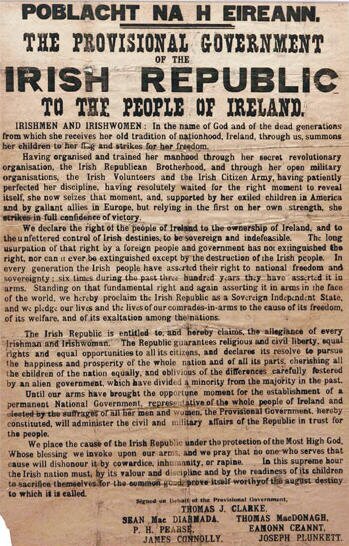
Join us for the 93rd Reading of the Easter Rising Proclamation of the Irish Republic at Tir na Nog in Baltimore's Inner Harbor, March 29 from 3:00-7:00, sponsored by Irish Northern Aid's Baltimore chapter.
The Proclamation will be read by Arthur Sands, Bobby Sands' cousin.
Music will be provided by Brendan Pelan and Nua.
A basket of cheer raffle and silent auction will be raising funds for The Pat Finucane Center and Coiste.
The restaurant will validate parking for the lot at Pratt & Light streets.
http://www.thepost.ie/breakingnews/ireland/eyaumhmhojcw/
19/03/2009 - 15:38:04
Detectives found garda uniforms, bulletproof vests and an extendable baton in a car they stopped in Dundalk just before Christmas 2007, the Special Criminal Court in Dublin heard today.
They also found two black bomber jackets with the logo "Republican Socialist Movement Dundalk" and an AK47 rifle and red star on the back.
A Dundalk man, Anthony Lee (aged 33), Carnbeg, Doylesfort Road has pleaded not guilty to membership of the INLA on December 20, 2007.
Opening the prosecution case, Ms Mary Ellen Ring SC said that gardaí investigating the activities of the INLA were on duty in Dundalk and the accused man was seen arriving at a housing estate in a black VW Passat car. He was later seen at the boot of the car and then getting in the passenger seat.
When detectives attempted to stop the car by putting on their blue flashing lights and siren, the Passat failed to stop and collided with another garda car which had tried to block the road.
The accused and the car’s driver were arrested and when gardaí searched the car boot they found garda uniforms, two bulletproof vests and the black bomber jackets. An extendable baton and gloves were found in the front of the car.
When Lee’s home was searched, an Irish Army issue bulletproof vest was found under the bed.
Ms Ring told the court that the prosecution case would consist of the opinion evidence of Chief Superintendent Patrick Magee that Lee was an INLA member and the evidence would be backed up by Lee’s presence in the car where the items were found.
The trial is continuing.
© Thomas Crosbie Media 2009
http://www.anphoblacht.com/news/detail/37872
No place in changed political landscape for armed actions
A SEASONED republican commentator, a former internee and republican prisoner who was an adviser to the Sinn Féin team negotiating the Good Friday Agreement, says that the political landscape in which the IRA fought its campaign has totally changed. The actions of the so-called ‘Continuity IRA’ and ‘Real IRA’ have no place in Ireland today and will only hinder the campaign for a united Ireland and an end to rule from Westminster.
Writing in his weekly Irish News column last Thursday (12 March), Jim Gibney says unequivocally “I am not a pacifist” but describes the killing of two British soldiers and a PSNI officer as “wrong, morally unjustifiable and indefensible” in the changed political circumstances.
“The nationalist community lives in real time. A time of peace, not conflict, where there has been real change,” Jim Gibney says.
“The partition of this island and the presence of some British garrisons are unacceptable to me.
“I am not a pacifist. I supported the IRA at a time when the nationalist community was really oppressed. I have supported other armed struggles in Vietnam and South Africa, to name but a few. Armed struggle can only be legitimate when measured against the real level of oppression and suffering and must enjoy real support.”
But, Gibney argues, the North today is not the same as the one he grew up in. The North was a one-party, sectarian state. It was one where unionists dominated and discrimination, censorship, bans, curfews, internment, and murderous attacks by state forces on protesters was the order of the day. It was a place where nationalist voters and their families and aspirations did not count. It was, Jim Gibney recalls:
“A society in the grip of a powerful system of armed forces backed by repressive laws, where nationalists had no place in their own country, a society where our cultural identity, our language, was criminalised. A society where our choices were limited to sitting at the back of the bus and voting for constitutional nationalist parties that sat at the back of the benches, or fighting for our civil and national rights.
Oppression is felt as a result of actions by state forces, as a result of unjust laws, as a result of people being deliberately forced to the margins of society.
That form of oppression no longer exists in the Six Counties – Jim Gibney
“The Peace Process and republicans changed all of that.
“Today, nationalists and republicans have significant political power and influence.”
In the first Executive, he says, Martin McGuinness and Bairbre de Brún between them controlled 70 per cent of the budget. Today Martin McGuinness is joint First Minister with the DUP’s Peter Robinson and nationalists and republicans are in other ministerial positions.
“Real change is represented by the all-Ireland Ministerial Council, by nationalist MLAs in the Assembly and various committees and in the strength and growth of the Irish language across the North.
“It is represented in the absence of British soldiers on our streets, in the absence of British fortresses, in the absence of a loyalist militia like the UDR or RIR, and in the dismantling of repressive laws.
“It is represented in the existence of the human rights and equality commissions, in the presence of republicans and nationalists on the Policing Board and in the new police service, the PSNI.”
The actions of armed micro groups who have usurped the name of the IRA have caused “widespread shock, anger and demoralisation among nationalists and republicans in whose name these Unreal IRAs claim to be acting”, including those who fought the war.
The leaderships of the ‘Real IRA’ and ‘Continuity IRA’ are “contemptuous of the opinion of the vast majority of republicans, men and women who really risked their lives, who sacrificed the best years of their lives in prison for freedom and who, in their collective wisdom, believe in the Peace Process.
The people of this island are in a new place and there is no space in that place for those who use violence in the perverse claim that by taking lives they can add to our lives
“Does all that really count for nothing in their minds?” the former internee asks.
Oppression cannot be contrived or manufactured, Jim Gibney says.
“It cannot be conjured up out of history books or carried forward from a deep hurt, personal or political. It cannot be a figment of one’s imagination nor can it be made real through political doggerel.
“Oppression is felt as a result of actions by state forces, as a result of unjust laws, as a result of people being deliberately forced to the margins of society.
“That form of oppression no longer exists in the Six Counties.”
Jim Gibney acknowledges there still is “a legacy of wrongs to be rectified as a result of partition and conflict” but, he adds, Sinn Féin and others are overcoming that legacy by using their political power and influence.
“The people of this island are in a new place and there is no space in that place for those who use violence in the perverse claim that by taking lives they can add to our lives.
“They will not.
“Armed struggle or armed actions have no part to play in bringing about a united Ireland. In fact, in today’s Ireland, they will delay and hinder that very objective.”
Articles may not be reproduced without the consent of An Phoblacht. For further information, please contact
http://www.anphoblacht.com/news/detail/37868
BY EMMA CLANCY
A SINN FÉIN delegation, including Belfast Mayor Tom Hartley and Assembly member Paul Maskey, met with representatives of the Ulster Political Reseach Group, linked to the UDA, for the first time last week.
Speaking after the meeting, held on 11 March, Tom Hartley described the historic discussion as “constructive” in the wake of the killings of two British soldiers and a PSNI officer by so-called dissident republicans.
“The principles which have underpinned the Peace Process have been inclusivity and dialogue,” Tom Hartley said.
“Today we met with representatives of the Ulster Political Research Group. In recent years there has been useful work done between loyalists and republicans in the city which has contributed to a series of peaceful summers.
“The events of recent days, which have seen three people killed and a number of others injured, have clearly raised tensions across the board. But this is a time for clear heads and decisive leadership.
“There can be no return to the failures of the past. Loyalists have an important part to play in ensuring this happens and that formed part of our discussions today.”
The Belfast mayor added: “Sinn Féin will continue to build the Peace Process. Its robustness has been demonstrated in the days since Saturday night. However, it is important that all of us in political leadership continue to redouble our efforts to maintain calm on our streets and see an end to these sorts of futile armed actions.”
SOCIAL ISSUES
Speaking to An Phoblacht this week, west Belfast Assembly member Paul Maskey said that Sinn Féin also discussed broader economic and social issues with the UPRG delegation.
“The groundwork for such a meeting to take place has been laid by community activists, republican and loyalist, over the past few years through cross-community dialogue and interface work to foster respect and keep our streets calm over the summer,” he said.
“We hope to continue to build on these lines of communication and dialogue, which are so vital in periods when tensions rise.
“Dialogue between representatives of Belfast’s working-class communities can play an important role in tackling many of the common problems we face,” Maskey added.
“These include fuel poverty and economic hardship, unemployment and social issues such as suicide, community safety, health and education.
“Our common experience of social deprivation and exclusion can be the starting point for discussions about our common strategies for the way forward.”
Frankie Gallagher from the UPRG viewed the meeting as positive, saying: “We made a conscious decision that we would meet Sinn Féin to demonstrate to these people [republican micro groups] they will not create any more division.”
Gallagher also said that while the UPRG and Sinn Féin have political and ideological differences, “there are many social and economic issues that we can work together on”.
Articles may not be reproduced without the consent of An Phoblacht. For further information, please contact
http://www.irishtimes.com/newspaper/ireland/2009/0320/1224243121570.html
BARRY ROCHE, Southern Correspondent
Fri, Mar 20, 2009
THE FINANCIAL adviser accused of laundering cash stolen in the Northern Bank raid yesterday denied that he had told former Bank of Scotland (Ireland) chairman, Phil Flynn, that he would be able to dispose of £10 million.
Ted Cunningham said that a memo of an interview given to gardaí off camera following his arrest in which he said that he told Mr Flynn that he (Cunningham) could take up to £10 million was not true. Mr Cunningham said he had been coerced into agreeing with details given to him by gardaí.
Mr Cunningham was respond- ing to cross-examination by prosecution counsel, Tom O’Connell SC who questioned him about a series of figures in his handwriting on a sheet of paper found by gardaí.
Mr O’Connell asked Mr Cunningham to explain the figures on the page which included figures such as “Pit 1.2m”, “Rahan 1.5m”, “Clonmore 1.5m”, “Chesterton 3.5m” and “Bulgarians 4.3m” and “10m” and “Fees 1m”.
Mr Cunningham said he could not remember what the figures meant or why he had written them down.
“Four years on . . . I can’t say what was in my head when I wrote this down – I’m always doodling with figures . . . I can’t say what they are actually related to – all my life I have just scribbled things down from time to time – I might just have been playing with figures.”
Mr O’Connell put it to Mr Cunningham that the figures tallied with the figures given in the memo of interview taken by gardaí on February 18th, 2005 which mentioned that he told Mr Flynn that he could taken £10 million but Mr Cunningham denied the memo was correct.
And he denied he had contradicted his statement to gardaí on February 17th, 2005 that former Sinn Féin councillor Tom Hanlon was not aware of £2.3 million in his home at Farran when he said in his direct evidence that Mr Hanlon had helped count the cash at the house.
Mr O’Connell asked Mr Cunningham to explain why he was now claiming that money he had given to the jewellers John and Jack Douglas in Tullamore had come from Bulgarians for the sale of the sand and gravel pit when he told them at the time it came from the sale of property in Dundalk.
Mr Cunningham said John Douglas had asked him what he was to tell his parents about the money when he asked him to mind it and he simply said to tell them that it came from the sale of property in Dundalk, even though there was no such sale.
The case continues before a jury at Cork Circuit Criminal Court.
© 2009 The Irish Times
http://www.christiantoday.com/
by Anne Thomas
Posted: Friday, March 20, 2009, 9:19 (GMT)
Three Protestant denominations in Northern Ireland have called on the government to introduce a temporary 11 plus exam for primary school students about to make the transition into secondary education.
When the last 11 plus exam was scrapped last year no clear mechanism was put in its place to determine which secondary schools the primary school students would progress to.
The Church of Ireland, Presbyterian and Methodist churches have criticised Sinn Féin Minister for Education Caitríona Ruane, saying that unregulated testing practised by grammar schools is creating confusion within Northern Ireland.
Uncertainty about testing and transferring to secondary schools represent “a failure in good governance”, they claim.
The Department of Education has resisted the retention of the exam, previously administered to students across Northern Ireland in their final year of primary school. It says that the Ms Ruane wants “a non-selective and inclusive process… [that does not identify] children as failures”, reports the BBC.
Rev Trevor Gribben of the Presbyterian Church said that the Churches' statement reflected the “huge unease” many people were feeling as a result of the uncertainty.
“It's amongst principals, governors and teachers in primary schools, who are being put under huge pressure. It's unease amongst parents of year six pupils and the pupils themselves, who do not want the potential chaos of an unregulated system," he said.
"People who are setting tests are trying their very best to get rid of that confusion, but nonetheless it exists.
"Government have a responsibility to do something about it and we are calling, even at this late stage, on the minister of education to sit down with the political parties to try and find interim agreed arrangements for transfer."
A number of Catholic grammar schools have said they will set their own independent tests, while over 30 state schools have said they will also continue to use tests despite the wishes of the Education Minister.
http://www.anphoblacht.com/news/detail/37863
BY ROBBIE SMYTH
IN early April, Sinn Féin TD Martin Ferris will present the first comprehensive report on the future of farming and fishing in the west of Ireland to the Oireachtas All-Party Committee on Agriculture, Fisheries and Food.
Ferris told An Phoblacht the project has been “the most rewarding work I have done in the Dáil” and an antidote to the “talking shop” that Leinster House is too often for the reserved Kerry man.
The 108-page report, The Future of Farming and Fishing in the West, unwraps a comprehensive overview of the agricultural economy of the west and includes a unique survey of farmers’ opinions, interwoven with a summary of the submissions received from 28 of the key interest groups in the sector.
Crucially, there are 36 key recommendations which, if acted upon, Ferris believes could start a process of transforming rural Ireland.
An Phoblacht asked Ferris about the process of the survey and the consultations begun last summer, asking what new knowledge had been gleaned from piecing together this comprehensive study.
“I knew it was bad,” said Ferris, who described the consultations and surveys as “an educational process” but he was particularly shocked as to “how dire it is in coastal communities”.
The report is, he says, “a true reflection of the state of farming and fishing in the west from the bottom up”.
When the Sinn Féin team travelled to farmers’ marts to conduct their surveys last summer many farmers were initially suspicious or sceptical of the survey but “were always very co-operative when we explained our purpose in conducting it”.
“Some farmers are barely existing,” said Ferris who in particular highlighted the plight of those working in fishing, beef and dairy sectors.
The way the milk system operates means that dairy farmers “need 50,000 gallon quotas or more to survive”, said Ferris, while beef farmers are “vulnerable to cartels who can bring down prices”, slashing farmer income.
Touching on the potential of farmers’ markets, Ferris said:
“They offer a chance for local producers to develop, and by packaging and marketing their produce properly it gives a great opportunity to make money.”
For this to work, and for farmers to diversify more into new products, specialist breeding and organic foods, farmers needed “information with the right support and the right encouragement”.
The North Kerry TD is determined that this report won’t be ignored. He wants the agriculture, fisheries and food committee to debate and discuss the findings and for it to become part of an agreed policy going forward.
Ferris hopes the Oireachtas committee will be “inviting all the stakeholders, to get a first-hand view on what they think of the report’s recommendations”.
He will keep raising it at committee level and will question the Minister for Agriculture, Fisheries and Food Brendan Smith, when he appears before them on a timetable for an implementation plan on the report’s recommendations.
For Ferris, the key issue is the goal of keeping as many people as possible on the land. He highlighted the case uncovered in the report of one farmer who in 2007 received over €500,000 through the single farm payment scheme while in the rest of Ireland the average payment was €9,871.
Completing this report is a substantial piece of work, but talking to Martin Ferris this week it is clear that the full effort is yet to come and the Sinn Féin Agriculture and Fisheries spokesperson is like fellow west coast Oireachtas member, Senator Pearse Doherty, only warming up for the next round of making government matter on the ground, as he says himself, “from the bottom up”.
FARM AID: Martin Ferris, Caoimhghín Ó Caoláin and Pearse Doherty pushing the Oireachtas for change in agriculture and fishing
The Future of Farming and Fishing in the West
An Phoblacht carries selected highlights of the Martin Ferris report on The Future of Farming and Fishing in the West. The report is a substantial piece of work so here are edited segments of three key sections of the report.
They are an overview of farming in the West, the state of the fishing industry and the survey on farmers’ outlook for the future.
Farming in the West of Ireland
Kerry, west Limerick, west Cork, Donegal, Clare, Galway, Roscommon, Mayo, Sligo and Leitrim make up the geographical context of this report. Between 1996 and 2006, the numbers working in farming and fishing fell by 39 per cent with a total of 18,511 people leaving the land and the sea.
One of the main motivations for this report is that, despite the claims of official policy and despite the creation of the CLAR programme, the relative decline of the west has continued.
There is also the perception that overall agricultural policy does not take account of regional disparities at an economic level. The Agri Vision 2015 Report does not refer to the relative disadvantage of the West in any of its 53 detailed recommendations.
The Single Farm Payment
As part of CAP reform, previous price supports were replaced with what is now called a Single Farm Payment (SFP). The Ferris report highlights serious inequalities in how this money is distributed.
The total of SFP paid to Irish farmers in 2007 was €1,229m, an average payment of €9,871 per farmer. 68 per cent of farmers got less than €10,000 which accounted for 28 per cent of the total.
On average, the bottom 68 per cent received a SFP of €4,057 compared to an average of €22,170 for the top 32 per cent of recipients. Indeed, the disparity in payments is even starker when one takes into account that 55,312 farmers, representing over 44 per cent of all recipients, received less than €5,000 in SFP.
Their payments accounted for just 10.5 per cent of the total. In contrast, the 2,092 (or 1.7 per cent) of farmers who received more than €50,000, accounted for €154m, an average payment of €73,500 and 12.6 per cent of the total fund.
The highest single payment received by one applicant in 2007 was €506,203!
Farming demographics
The overall number of farms in the state has fallen from 228,000 in 1975 to 128,000 in 2006. While the number of farms under 50 hectares has fallen by over 45,000 since 1990, there are now almost 23,000 farms of 50 hectares and more compared to 18,600 in 1990.
This trend of a decrease in small farms but an increase in larger ones raises the question as to whether it is possible to retain a significant number of smaller-scale family farms.
Although the BMW region contains almost 53 per cent of all farms in the state, those farms only have 36.7 per cent of farm machines. Farmers in the West tend to be older, with 24.4 per cent aged 44, and younger in the BMW region in 2005 compared to 30 per cent for the rest of the country.
Overall employment in the agri-food sector was 171,400 in 2007 with 109,700 directly employed in agriculture. The proportion of people in the West employed in farming and fishing still remains much higher than the national average at over 7 per cent compared to 4.6 per cent for the state as a whole. Roscommon, at 10.1 per cent, had the highest proportion in this sector.
It has been forecast that farm numbers will fall to 105,000 in 2015 with just 33 per cent of them viable and approximately 22,000 farmers will cease production.
Western farmers have the poorest employment prospects due to educational attainment and skill levels. Fifty-six per cent of farmers in Galway, Roscommon and Mayo had only primary education. In Roscommon, the average for farmers of 52 per cent was far higher than 31 per cent for the population of the county as a whole. The long-term prospects, even with eventual economic recovery are for a marked decrease in the type of jobs most common to farmers in off farm employment.
Agricultural trends and opportunities
Dairying in the Western counties is in clear long-term decline with the value of output continuing to fall. Milk production in the BMW region fell from 24 per cent in 2004 to 22.4 per cent in 2006. For example, it is estimated that of the approximately 2,000 dairy farmers in Kerry at the present time that only around a half will be viable in the long-term.
The production of energy crops is a key area in which farmers are being encouraged to participate. Only 200 or less than 0.1 per cent of farmers were engaged in the production of alternative energy in 2005. That compared to an EU average of 0.4 per cent of farms engaged in energy crop production.
However, the area of willow and miscanthus grown in Ireland has increased in the last two years, from 300 hectares in 2006, to 1,100 hectares in 2007. The area under oilseed rape, used to produce liquid biofuel, increased from 4000 hectares to 6000 hectares in 2007.
Under its Wood Energy Strategy and Action Plan, the Western Development Commission forecasts a 300 per cent growth in the wood energy sector over the next ten years which would add €15m annually to the region’s income and create up to 900 full-time jobs as well as saving 620,000 tonnes of CO2 emissions every year. When fully operative it would have a demand from local farmers for 472,000 tonnes of thinnings worth €1.7m annually.
Local production and farmers’ markets
Locally-produced and marketed food is an area that has been growing as farmers attempt to increase margins by selling directly to the consumer. It reflects dissatisfaction with the falling share of the retail price accruing to producers. On the consumer side, it reflects a growing interest in healthier food.
There are 147 farmers’ markets throughout the 32 Counties with the exception of Fermanagh. Thirty-seven of the markets are in the Western counties, which is a clear indication of strong interest and potential there.
Organic produce
In 2005, just 0.8 per cent of agricultural land in Ireland was farmed organically, compared to an EU average of 4.3 per cent. That increased slightly in 2006 with 1,260 registered operators in Ireland of whom 1,104 were farmers/growers farming 39,665 hectares, which represents approximately 0.9 per cent of agricultural land.
The National Steering Group for the Organic Sector has set a target of 3 per cent of UAA to be either fully organic or in conversion by 2010.
Fishing in the West
The Irish fishing fleet consisted of 1,935 vessels at the end of 2007 with a total tonnage of 64,489 tonnes. Just 2,400 people were directly employed in fishing in 2007, though Bord Iascaigh Mhara estimates that over 11,000 are employed directly and indirectly, including processing and ancillary services. Processing accounted for 2,867 jobs in 2005/2006 with 77 per cent of the jobs being full-time.
In 2007, seafood exports were 158,000 tonnes valued at €360m. That represented an increase in value of 31 per cent since 1995. While seemingly impressive, that must be compared to an increase of 138 per cent in exports from Spain, 76 per cent for France, 94 per cent for Portugal and 60 per cent for Britain and the North.
The relatively poor performance of the Irish export sector is even more pronounced when it is taken into account that countries like Portugal, Greece, and Sweden have overtaken this country and that Italy, which had almost identical exports in 1995, now exports €562m annually.
Total domestic seafood sales in 2007 were €394m, meaning that 43 per cent of this was accounted for by imports. Given that a high proportion of those imports consist of products based on fish which can be caught in Irish waters, there is obviously scope for import substitution. That, however, would require a radical change in the management and structure of the Irish fisheries as it relates to quota.
Since 1993, the Irish fleet has been reduced by over a third and the intention is clearly to accelerate the rate of decommissioning. The clear intent, and one that is accepted by Irish officials, is to reduce the fleet to one operating from two or three large ports.
Aquaculture here has grown from an output of 27,000 tonnes in 1990, which was just 2.8 per cent of EU output, to 60,000 in 2005 which amounted to 4.7 per cent of output for all EU member states. That fell to 56,000 tonnes with a value of €124.6m in 2006. There are currently approximately 2,000 people employed in the sector and aquaculture accounts for around 30 per cent of the total output value of Irish seafood.
The farmers’ survey
Almost 200 farmers were interviewed in west Cork, Kerry, Galway, Mayo, Sligo and Donegal attending marts during summer and autumn 2008. Six out of ten (59 per cent) felt that their situation had worsened since the introduction of the Single Farm Payment. More than eight out of ten (82.4 per cent) of sheep farmers felt their situation was worse. A similar number (84.3 per cent) felt they were at a disadvantage compared to farmers in other regions. 37.9 per cent didn’t think they would be involved in farming within ten years.
Input costs, output prices red tape and regulations were the biggest challenges facing farmers. Jobs, decline of community and depopulation were the three biggest challenges facing rural Ireland, according to the survey asking the people to whom it matters – farming and fishing families.
Articles may not be reproduced without the consent of An Phoblacht. For further information, please contact
http://www.irishtimes.com/newspaper/breaking/2009/0320/breaking43.htm
JOHN COLLINS and PAMELA NEWENHAM
Fri, Mar 20, 2009
Computer maker Dell is set to cut up to 230 jobs after the company told staff in Dublin and Limerick that further cuts were required as part of a $4 billion restructuring plan.
Dell had previously sought to make savings of $3 billion in its business worldwide but has now increased the figure in the face of what it has described as a “a global downturn in IT spending”.
The Irish Times understands that Dell is identifying specific areas where it can reduce staff numbers and redundancies will not be voluntary.
The announcement was made at meetings with the company’s 2,300 staff this morning. The company employs 1,300 people in Cherrywood in south Co Dublin and 1,000 workers in Limerick.
Labour party TD Jan O’Sullivan said the announcement represented an economic catastrophe for Limerick and the mid-west region and a personal tragedy for those who are now to lose their jobs.
“This announcement is particularly disappointing, given that the workforce in Limerick was given an indication that they would not be asked to take any more punishment after the previous round of redundancies,” she added.
Fine Gael Limerick East TD and deputy finance spokesman Kieran O’Donnell TD said: "These are the very jobs we had hoped to build on in Limerick following January’s announcement of 1,900 manufacturing job losses in Dell…the fact that high-end jobs in business development, innovation and research and development are going is a very worrying development."
In January, the company announced 1,900 job losses at its Limerick plant following the decision to move its computer manufacturing base to Poland.
© 2009 irishtimes.com
http://www.contactmusic.com/new/film.nsf/reviews/hunger
Awake with blunt noise and images of stunning clarity, Steve McQueen's Hunger only indulges in one real section of dialogue. Most of the film, set in Northern Ireland's infamous Long Kesh (Maze) prison, frames this conversation, one between a priest and an inmate. Filmed 17 times and clocking in at over 25 minutes long, McQueen allows for this central dialogue about the "Troubles" and how they relate to religion and protest, but his real aim is to let you experience the sound and physicality of the dialogue of revolution. Full of echoing drips, clattering batons, wet grunts, and bludgeoning exclamations, McQueen's film might have been easier to ignore if said inmate wasn't Bobby Sands, the controversial martyr of the IRA stronghold that died from a hunger strike he enacted in response to the restriction of rights imposed on Sands and his IRA brethren at the Maze.
This fact is largely rendered moot, however: McQueen changes up his central character rather randomly, from Sands to a fellow inmate to a doomed guard. It's 30 minutes into the film before Sands is introduced and, thanks to the Gaelic accents, it's not even clear what his name is until the dialogue with the priest commences. The only other tip is that he is played by Michael Fassbender, the German-born actor of 300 fame. (For the many, like myself, who found it a somewhat tumultuous task to tell one Spartan from another, he was the one who answered "Then we shall fight in the shade.") Though we never witness a proper verbal retort to Margaret Thatcher's "A crime is a crime is a crime," watching Fassbender waste away speaks volumes. A Hollywood remake might highlight this line: "Then we shall use what God gave us."
Opening on a storm of clattering plates, a poverty-stricken Irish lower-class using what they have to demand food, McQueen's film sharply turns to a guard checking his car for bombs. With the IRA summarily executing loyalists, prison guards, and police officers, waking early to check if there's C-4 strapped to your engine block isn't the most ludicrous idea. This specific guard (Stuart Graham) gets his anger out during the ritualized beatings and forced grooming of the inmates at Long Kesh. But before Sands gets to the plate, the guards try their hands on newbie inmate and IRA devotee Davey (Brian Milligan). Davey is followed as the guards enact a mandatory end to the "no wash" protests, a forced bathing and cutting of hair. This is where we finally meet Sands.
Hunger is mainly constructed as a study in juxtaposition. McQueen makes visual splendor out of the most heinous of acts, pausing after a beating to watch a sink of clear water turn a hazy pink as the guard soaks his scraped knuckles. The stunning still shot of the inmates funneling their urine into the cell block could have been a powerful short film all on its own. Yet, this is not a film based solely on its imagery, as haunting and peerless as Sean Bobbit's cinematography is. A major facet of Hunger's seduction is dependent on its detailed use of sound. It is surely no mistake that the more Sands withers away, the more minimalist McQueen and sound designer Paul Davies render the surrounding commotion, at one point supplying nothing but the wind and Sands' cavernous exhales.
Chronicling the days leading to the strike up to the loading of Sands' corpse into the coroner's van, Hunger is a starkly realistic counterpoint to the often-lyrical treatment in film of the British/Irish "Troubles." Built almost entirely on verbal rhetoric, films have largely centered on the nationalist struggle (Ken Loach's The Wind That Shakes the Barley) or irate tragedy (Paul Greengrass' excellent Bloody Sunday), with a few obscurities between. (Where would one put John Boorman's massively entertaining The General in the lineage?) McQueen stages the argument centrally, but the film is steeped in the body -- the brawny flesh of the struggle. Starving the body to skin and bone, rubbing excrement and vomit on the walls, funneling urine into the cell block.... The body, itself, has become rhetoric.
That's not wallpaper.
Reviewer: Chris Cabin
Updated: 8/26/2009


Use the Guest Book to Comment on the web site or individual stories.
To get Irish News updates emailed to you