Irish Northern Aid
News

 |
||||
http://republican-news.org/current/news/2009/10/psni_stretched_by_attack_alert.html
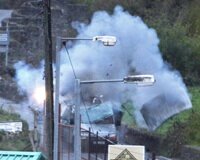
Claims that a republican group abandoned a massive van bomb in a border village this week proved unfounded after a dramatic controlled explosion by the British Army revealed the van to be empty.
The alert took place on a bridge in Clady, which straddles the border between Counties Donegal and Tyrone. A van had been parked on the road, and left with its hazard lights flashing.
Following the van’s destruction, the incident was described as an “elaborate hoax” by crown forces.
In a separate incident this morning, a small device exploded underneath a car in east Belfast. The device was said to have caused slight injuries to the partner of a member of the PSNI police, the apparent target of the attack.
No group has claimed responsibility for either incident, which have fuelled renewed tensions over dissident attacks in the North.
Ulster Unionist councillor Derek Hussey said he “unreservedly condemned” the disruption caused by the Clady bomb alert.
“The closure of a cross-border road has caused a great deal of traffic disruption” he said.
“An incident such as this only serves to heighten concerns within the community, particularly in the context of the recent dissident activity across the province.”
West Tyrone Sinn Fein MP Pat Doherty said local residents were “apprehensive”.
“Whoever parked the van there or planted the device - if there is a device - really needs to catch themselves on. It’s a disgrace.”
There were also condemnations of the incident in east Belfast, which took place less than half a mile from the giant Crown force complex at Castlereagh.
Damage could be seen under the front of the vehicle, a valuable red MX5 sports car. The PSNI later erected screens to prevent onlookers watching them as they carried out an inch-by-inch search of the scene.
“This is a quiet residential area and if it is the case of a police officer being targeted, I think it is a very serious development,” said Ulster Unionist leader Reg Empey.
“We are arguing the toss and we are giving ammunition to the dissident republican agenda.”
In other incidents around the North, dozens of office workers were evacuated during an alert in central Belfast on Wednesday morning. A suspicious package was said to have been left inside an office block beside the Europa bus station, but nothing was found.
Additionally, a caller rang a Belfast newsroom to say a suspicious device had been left near a garage on the Stewartstown Road in Belfast, but again nothing was found, while there was also a false alarm in Limavady, County Derry.
This morning’s attack was considered unusual in that it took place in Belfast city and also involved a successful detonation. Located in a strongly unionist area, there were also suggestions that loyalists may have been involved.
“This is a very serious development, it clearly shows the intent of those responsible,” said Ian Paisley Jr.
“If it turns out to be dissident republicans, it confirms the view that they’re prepared to go to any length to either kill a police officer or someone else in the community to make their point,” he said.
http://republican-news.org/current/news/2009/10/there_was_no_deal.html
The following is the final article by Sinn Fein President Gerry Adams for the Irish News on the recent controversy over the 1981 hunger strike:
Twenty-eight years ago, 10 Irish republicans died over a seven-month period on hunger strike, after women in Armagh prison and men in the H-Blocks (and several men ‘on-the-blanket’ in Crumlin Road Jail) had endured five years of British government sanctioned brutality.
The reason for their suffering was that in 1976 the British government reneged on a 1972 agreement over political/special category status for prisoners which had actually brought relative peace to the jails.
You would not know from reading Garret FitzGerald’s newly-found ‘memory’ of 1981 in the recent Irish News series that in his 1991 memoir he wrote: “My meetings with the relatives came to an end on 6 August when some of them attempted to ‘sit in’ in the government anteroom, where I had met them on such occasions, after a stormy discussion during which I had once again refused to take the kind of action some of them had been pressing on me.”
This came after a Garda riot squad attacked and hospitalised scores of prisoner supporters outside the British embassy in Dublin only days after the death of Joe McDonnell. It is clear from FitzGerald’s interview and from his previous writing that his main concern, before, during and after 1981, was that the British government might be talking to republicans and that this should stop.
With Thatcher he embarked on the most intense round of repression in the period after 1985. Following the Anglo-Irish Treaty of that year the Irish government supported an intensification of British efforts to destroy border crossings and roads and remained mute over evidence of mounting collusion between British forces and unionist paramilitaries.
The same FitzGerald was portrayed as a great Liberal, yet every government which he led or on which he served, renewed the broadcasting censorship of Sinn Fein. This denial of information and closing down of dialogue subverted the rights of republicans. It also helped prolong the conflict.
The men who died on hunger strike from the IRA and INLA were not fools. They had fought the British and knew how bitter and cruel an enemy its forces could be in the city, in the countryside, in the centres of interrogation and in the courts.
The Hunger Strike did not arise out of a vacuum but as a consequence of frustration, a failure of their incredible sacrifices and the activism of supporters to break the deadlock.
Part of the problem was that the Irish establishment, including the Dublin government, the SDLP and sections of the Catholic hierarchy had bought into British strategy.
This was actively supported by sections of the Catholic establishment in the north including The Irish News.
The prisoners, our comrades, our brothers and sisters, resisted the British in jail every day, in solitary confinement, when being beaten during wings shifts, during internal searches and the forced scrubbings.
In December 1980 the republican leadership on the outside was in contact with the British who claimed they were interested in a settlement. But before a document outlining a new regime arrived in the jail the hunger strike was called off by Brendan Hughes to save the life of the late Sean McKenna. The British, or sections of them, interpreted this as weakness. The prisoners ended their fast before a formal ‘signing off’.
And the British then refused to implement the spirit of the document and reneged on the integrity of our exchanges.
Their intransigence triggered a second hunger strike in which there was overwhelming suspicion of British motives among the hunger strikers, the other political prisoners, and their families and supporters on the outside.
This was the prisoners’ mindset on July 5 1981, after four of their comrades had already died and when Danny Morrison visited the IRA and INLA hunger strikers to tell them that contact had been re-established and that the British were making an offer. While this verbal message fell well short of their demands they nevertheless wanted an accredited British official to come in and explain this position to them, which is entirely understandable given the British government’s record.
Six times before the death of Joe McDonnell, the Irish Commission for Justice and Peace (ICJP), which was engaged in parallel discussions with the British, asked the British to send an official into the jail to explain what it was offering, and six times the British refused.
After the death of Joe McDonnell the ICJP condemned the British for failing to honour undertakings and for “clawing back” concessions.
Richard O’Rawe, who had never met the hunger strikers in the prison hospital, never met the governor, never met the ICJP or Danny Morrison during the hunger strike, and who never raised this issue before serialising his book in that well-known Irish republican propaganda organ, The Sunday Times, said, in a statement in 1981: “The British government’s hypocrisy and their refusal to act in a responsible manner are completely to blame for the death of Joe McDonnell.”
Republicans involved in the 1981 hunger strike met with the families a few months ago.
Their emotional distress and ongoing pain was palpable.
They were intimately involved at the time on an hour-by-hour basis and know exactly where their sons and brothers stood in relation to the struggle with the British government.
They know who was trying to do their best for them and who was trying to sell their sacrifices short.
More importantly, they know the mind of their loved ones.
That, for me, is what shone through at that meeting.
The families knew their brothers, husbands, fathers. They knew they weren’t dupes. They knew they weren’t stupid. They knew they were brave, beyond words and they were clear about what was happening.
All of the family members, who spoke, with the exception of Tony O’Hara, expressed deep anger and frustration at the efforts to denigrate and defile the memory of their loved ones. In a statement they said: “We are clear that it was the British government which refused to negotiate and refused to concede their [the prisoners’] just demands.”
http://u.tv/News/Bomb-explodes-in-east-Belfast/38465841-d11b-45df-a39c-a3e54b8071d4
Police said the device planted under the car of a policeman's partner in east Belfast had been designed to cause death or serious injury. Chief Superintendent Brian Maguire said: "The Army technical officer has confirmed this was a viable device capable of causing death or serious injury.
"We are investigating the possibility that this was an under-car booby-trap device."
'Loud bang'
The 38-year-old policeman's girlfriend was taken to the Royal Victoria Hospital for minor injuries and was later discharged. She was reversing a red MX5 sports car out of the drive of the semi-detached house at Kingsdale Park at 7.30am when there was an explosion under the front of the car.
One neighbour said they had been woken by "a loud bang".
The bomb was fitted under the front passenger side of the two-seater car and Mr Maguire said: "Had a person been sitting in the passenger side, we may be talking about a fatality here today."
He declined to point the finger of blame at any organisation, saying: "Investigations are at a very early stage and all avenues are being explored."
He added that police officers had, for some time, been advised to check under their own vehicles.
"We are aware there is a serious threat and that has been the case for some time."
He confirmed that the woman had no direct link, past or present, with the police service but said detectives were investigating whether a serving officer was the intended target of the bomb.
Kingsdale Park remained sealed off for hours while forensic experts combed the area for clues.
The soft-top car remained behind screens half in the drive and half across the road.
'Evil act'
First Minister Peter Robinson said the attack was an "evil act designed to murder a police officer."
"I condemn it in the strongest possible terms."
"Those responsible have nothing to offer and must face the full rigours of the law."
"Undoubtedly those responsible are determined that Northern Ireland should be plunged back into the dark days of the past. They will not succeed."
The attack comes amid ongoing negotiations between Stormont and Prime Minister Gordon Brown over the stalled devolution of policing powers.
Arriving back in Northern Ireland after cutting short an engagement in London, the First Minister said the murder bid highlighted the importance of securing the resources to tackle the dissident republican threat.
Deputy First Minister Martin McGuinness said he condemned an attack which had obviously been intended to kill.
He said: "The vast majority of people want a future together in peace. The people of Ireland overwhelmingly support the peace process. They want the political institutions and progress to continue.
"Attempts like this to derail the peace process must not be allowed to succeed."
Policing Board member Ian Paisley Junior has also condemned the attack.
"This is a very serious development, it clearly shows the intent of those responsible."
"If it turns out to be dissident republicans, it confirms the view that they're prepared to go to any length to either kill a police officer or someone else in the community to make their point," he said.
East Belfast MLA and Ulster Unionist Party leader Sir Reg Empey said: "This is a quiet residential area and if it is the case of a police officer being targeted, I think it is a very serious development."
Police Federation chairman Terry Spence also condemned as cowardly and reckless the attack.
"All police officers and the wider police family must be vigilant about their personal security. Today's attempt to kill an officer was fortunately unsuccessful but we must be on our guard," he said.
Policing Board chairman Barry Gilligan said the victim was lucky not to be injured.
"They must not be allowed to inflict their vile terror on our community and I would urge anyone with information to pass it to the police."
Security Minister Paul Goggins said the attack was repulsive.
"News of this attack will repulse people across Northern Ireland. The remarkable progress that Northern Ireland has made over the past decade will not be derailed by criminals operating under the cover of darkness."
http://www.anphoblacht.com/news/detail/39031
THE most senior coroner in the Six Counties, John Leckey, is to withdraw from hearing the Pearse Jordan inquest.
Lawyers for Leckey revealed the coroner’s decision in the High Court in Belfast last week.
Leckey was in the High Court last week defending himself against allegations by the Jordan family that he was biased in his handling of the long-delayed inquest into the RUC shooting of Pearse Jordan in 1992.
Jordan, an IRA Volunteer, was shot dead by the RUC on the Falls Road in November 1992. The 23-year-old was unarmed when he was gunned down although the RUC initially issued statements claiming he was armed.
The inquest into the Jordan killing has been consistently delayed in the 17 years since his death.
ACCUSED OF BIAS
Earlier this year, Hugh Jordan, the dead Volunteer’s father, brought a case to the Belfast High Court where he accused Leckey of bias and sought his removal from the inquest into his son’s killing, which is due to sit in the near future, possibly January.
That judicial review was dismissed.
Last week, Hugh Jordan was appealing that dismissal when Leckey, in a decision that pre-empted the Appeal Court’s ruling, revealed that he would indeed withdraw from hearing the Jordan inquest.
The first day of the appeal heard that trust had broken down between the Jordan family and Leckey.
Barry McDonald QC, representing the Jordan family, told the Appeal Court:
“John Leckey appeared to disbelieve the family and suspected they might compromise the anonymity of inquest witnesses.”
The identity of the RUC man who shot Pearse Jordan dead has never been disclosed to the family and in any of the preliminary hearings held to date the killer has only been identified as ‘Sergeant A’.
The family maintain they have the right to know the identity of the man who killed Pearse.
The family’s barrister further claimed:
“At previous inconclusive hearings, the coroner predetermined the outcome of applications for the granting of anonymity and/or screening of witnesses.
“It seems the coroner actually disbelieves the representatives who act on behalf of the appellant and, in addition, seems to believe that if information had come into their possession it would have been used to undermine or compromise the anonymity of the police officers involved in this matter.”
Volunteer Pearse Jordan Hugh Jordan Father of Pearse
APPEAL TO IRISH GOVERNMENT
IRA Volunteer Pearse Jordan was shot dead by undercover RUC members on the Falls Road in West Belfast in November 1992. The car he was driving was rammed by the RUC and as Pearse staggered away from the car, he was shot three times in the back.
In May 2001, the European Court of Human Rights delivered a landmark ruling which found that the British Government had violated human rights laws in the controversial killing of Pearse Jordan and that of several other nationalists and republicans.
In response to the European Court rulings, the British Government promised a package of measures aimed at satisfying the families of those killed. This package of measures was described as “wholly inadequate” by Sinn Féin’s Bairbre de Brún, and Pearse’s father, Hugh, has appealed to the Irish Government to reject the measures, demanding a new and independent investigation into his son’s murder.
In November 2002, Hugh Jordan said:
“For ten years we have been trying to get justice through the British courts system but we have been frustrated at every turn. This has done nothing to weaken our determination to see justice done, no matter how long it takes.”
http://www.irishtimes.com/newspaper/frontpage/2009/1016/1224256789057.html
NEWSPAPER circulated to tens of thousands of prisoners in British jails has been criticised by an Irish welfare group for carrying a series of anti-Irish jokes in two recent editions.
The newspaper, Inside Times , carried two jokes submitted by prisoners in its September issue, and then dismissed complaints from Irish prisoners in its October issue, when it carried a third joke.
One joke reads: “A condemned man sat in the electric chair awaiting his execution, but there was a fault. They called in Paddy the electrician to try and sort out the problems. After two hours, he still hadn’t found it and told the Governor, ‘This thing is a bloody death-trap.’”
A second read: “An Irishman goes for a job on a building site. The boss asks, ‘Can you brew tea?’ Yes, he says. The boss then asks, ‘Can you drive a fork-lift?’ ‘Why, how big is the tea-pot?’” Describing the jokes as “deeply offensive”, an Irish prisoner wrote to the newspaper to complain they implied Irishmen “are basically stupid”, and asked if similar jokes would have been directed at black people or Muslims.
In reply, the newspaper quoted the late Irish comedian Dave Allen who once said: “You might as well laugh at yourself once in a while – everyone else does.” This, the newspaper said, was “sound advice at any time”.
The newspaper, run by a charity, the Newbridge Foundation, and circulated to 46,000 prisoners through prison libraries, could fuel anti-Irish prejudice in jails, said Conor McGinn of the London-based Irish Council for Prisoners Overseas.
The publication of the first jokes was “shocking enough”, said Mr McGinn, but “the editor’s response to my and Irish prisoners’ complaints was absolutely disgraceful. I have since been in contact with Inside Times and they are unrepentant. They have said the jokes weren’t racist and that ‘someone always has to be the butt of the joke’, but were unable to provide a single incidence of another ethnic minority community being targeted in this way.”
Denying the paper had been racist, Inside Time operations director John Roberts said he had asked Mr McGinn to write to him to explain “so that we can see exactly what the issue is”. “We do not do anything with a view to offending people. Obviously, it isn’t our intention to do so,” said Mr Roberts, who is married to an Irishwoman.
“The whole object is to make people’s lives easier in prison.”
http://www.irishcentral.com/news/Yankees-pull-plug-on-Ronan-Tynan-after-tenors-bad-joke-about-Jews-64484062.html
Ronan Tynan, the famed Irish tenor, has apologized for anti-semitic remarks he admits having made which has cost him his regular Yankees 7th inning stretch appearance to sing 'God Bless America' and may damage his career.
Tynan made the remarks to a Jewish doctor who was seeking an apartment in his building on Manhattan's East Side. "It was stupid of me to be so callous, and I would never want to hurt anybody's feelings," Tynan told NBC news in New York after the story surfaced.
According to NBC the incident happened when the 49-year-old Tynan met a real estate agent who was showing an apartment on his floor to a potential buyer, a Jewish pediatrician from NYU Medical Center.
The real estate agent said to the tenor “Don’t worry they are not Red Sox fans,” according to the apartment-hunter, Dr. Gabrielle Gold-von Simson.
To which Tynan replied, "I don’t care about that, as long as they are not Jewish," Gabrielle Gold-von Simson told NBC New York.
“Why is that?” asked a flabbergasted Gold-von Simson of the singer. Tynan replied that Jewish ladies had been looking at the apartment before and they were "scary," according to Gold-von Simson.
The singer now says the remarks were made in jest. The doctor said not. "I didn't know him at all so how could I take it as a joke," said Gold-von Simson. Tynan for his part claims was just a “big misunderstanding.”
“I’m not anti-Semitic and I have never been in my life,” Tynan told NBC New York. “There are three members of my band that are Jewish. And I love them like brothers. I call them my brothers from another mother.”
Tynan is famous for singing "God Bless America" at Yankee Stadium and “Ava Maria” at the funeral of Ronald Reagan
Famed Irish tenor puts foot in mouth instead of singing with it
http://www.irishcentral.com/news/Aer-Lingus-planning-to-end-US-Shannon-direct-route-63847652.html
Aer Lingus has proposed to terminate the direct New York to Shannon route early next year.
In further cost cutting attempts, which has already seen the loss of 676 jobs, the Irish airline plans to remove its U.S. base at Shannon airport, resulting in a loss of 102 cabin crew positions.
Chief Executive Christoph Mueller announced to over 120 Aer Lingus workers in a presentation on Thursday evening that the airline will instead run a three day a week New York/Shannon service via Dublin which will be staffed by Dublin-based employees.
Reports say Aer Lingus employees were in tears after hearing the decision, which will result in the loss of 75 percent of the Shannon cabin crew staff. The remaining 34 crew members will operate the three times a day Shannon/Heathrow service.
Aer Lingus’s director of corporate affairs Enda Corneille told reports after the announcement, “The job we all we have to do is to ensure that there is a viable future for the company. It is not just about Shannon. It is about Aer Lingus in total.”
“The news today and yesterday has been overwhelming for staff. This has been a very grave time for Aer Lingus and Aer Lingus people,” he added.
The drastic cuts at the airline are part of an attempt to save €97 million. The company reported a €93 million loss for the first six months of 2009.
Corneille revealed that CEO Mueller plans to meet with Shannon Aer Lingus employees again in the near future so that they can share alternative ideas on the jobs cut plan.
Spokesman for the Impact trade union Gerry Clarke told the Irish Times: “There is disappointment because the region seems to be targeted again,” while an anonymous worker told said: “The Shannon New York service is a very good product that has never been properly marketed by the company.”
http://www.irishcentral.com/news/Irish-American-activists-pressure-government-over-Laundries--64420237.html
Irish American activists are seeking to make the Irish government responsible for the maltreatment of young Irish women forced to work in Laundries. According to Mari Steed, spokeswoman of the group Justice for Magdalenes, the Irish government was complicit in the abuse the women suffered. It owes them an apology and compensation.
“Right now we’re encouraging everybody to contact ministers,” she says. “The thing is, we don’t want to lose focus. We’d like to keep the wave rolling.”
Last week, Minister for Education, Batt O’Keeffe, wrote in response to Parliamentary questions put to his department: “the Magdalene laundries were privately owned and operated establishments which did not come within the responsibility of the State and were not subject to State regulation or supervision.”
But the women were Irish citizens and deserved protection, Justice for Magdalenes asserts. Some were children and should have been at school. The state knew of the abuse and allowed it to go on.
“In 2009 the state is denying any role or function in these institutions,” says James M. Smith, an associate professor at the English department and Irish studies program at Boston College. “But the state’s fingerprints are all over this. The state is now conveniently scapegoating the Catholic Church when in fact church and state were partners throughout most of the twentieth century.”
A young girl at the Magdalene laundries
It is hard to know how many women were in the laundries because the religious orders that ran them have not released their records. When they left the Laundries the women tended to emigrate. Many survivors are in the US.
“There are women in America – women in New York, probably in Philadelphia and Chicago too,” Smith says, “wherever there were large Irish communities in the 1940s and 1950s. Many went into nursing assistant jobs, into healthcare – into institutions, not dissimilar from what they had left.”
American parents adopted the children of Magdalene women. “Between 1948 and 1971 more than 2,100 children were brought from Ireland to America for adoption,” Smith explains. “Many of the mothers likely would have been in Magdalene Laundries.”
The Ryan Report highlighted the abuse children suffered in industrial schools and other institutions. Yet in 2,600 pages, the word “Magdalene” featured just once, in a background chapter, Smith says.
The Irish government has apologized to other victims of abuse, but it denies responsibility for what happened to the Magdalene women because it says they were private institutions.
In a letter to the Taoiseach last month, Smith wrote, “The State's judicial system routinely referred women to the Magdalene laundries. From my own research, I can document at least fifty-four instances dating from the mid-1920s to the mid-1960s.”
Case files show how courts charged women with concealment of birth and would suspend the sentence if the women agreed to enter a Laundry, Smith argued. No records exist to document whether the women were released.
Smith put forward a scheme for compensating the women, but the government has rejected the plan.
Irish women’s groups support Justice for Magdalenes. “Women in the Magdalen Laundries were in positions of forced labour with no wages, access to trade unions or rights as workers,” said a spokesperson for the National Women’s Council of Ireland. “Slavery is what they experienced. The survivors deserve what they ask for – which is for their case to be brought to the Redress Board, an apology from the state and compensation for the injustice they have experienced.”
But in an email to Irish Central on Monday, the Minister’s for Education’s spokesperson said: “The abuse of any person is an abhorrent and shameful act regardless of the setting. However, this does not mean that the Government is liable for all incidents of abuse nor is it the function of the Government to determine liability in this matter.”
The Irish government has already paid just under 1.3 billion euros to victims of child abuse, Smith says. Especially in the current economic crisis, additional payments to victims of the Magdalene Laundries could be a problem for the government’s coffers.
Mari Steed herself is the daughter of a former Magdalene. Her mother is now 77 years old, but the ten years she spent in a Magdalene Laundry still affect her. She keeps her house meticulously clean, scrubbing the floor when it is already spotless
A US family adopted Steed and she grew up in Philadelphia. An articulate woman with shoulder-length black hair, Steed now gives talks and writes letters to Irish newspapers. She has set up a facebook group and runs the website magdalenelaundries.com.
Smith is the author of Ireland's Magdalen Laundries and the Nation's Architecture of Containment, a book that won him the distinguished First Book award at the American Conference for Irish Studies in 2007.
Other North Americans are starting to take notice. Marie C. Croll, a Canadian scholar who studies the Laundries, recently wrote a letter to the Irish Independent entitled “World is Looking at You, Minister” asking, “How can the State openly discriminate against these women and children, as members of your nation?”
“I would urge Irish-Americans to go onto Irish papers and submit a letter to the editor,” Smith says. “And to go to the Irish government website and email the Minister for Education’s office.”
Meanwhile the survivors are getting older. “It’s so important for us to get oral histories, and to try to get compensation for them,” Mari Steed says. “They’re going to start dying out. Perhaps that’s what the government is hoping.”
Updated: 11/5/2009


Use the Guest Book to Comment on the web site or individual stories.
To get Irish News updates emailed to you