Irish Northern Aid
News

 |
||||












http://www.irishecho.com/newspaper/story.cfm?id=19202
By Ray O'Hanlon
April 8, 2009 The British Ambassador to the United States, Sir Nigel Sheinwald, has rejected a request by the Brehon Law Society and a number of other Irish American groups calling for a full, independent inquiry into the 1989 murder of Belfast lawyer Pat Finucane.
The Brehons wrote Sheinwald expressing disquiet at what they said was the continued British government effort to "frustrate" the desire of the U.S. Congress to see a full independent inquiry take place into the Finucane murder.
In the letter to Ambassador Sheinwald, the Brehons stated that members of the society, as well as signatories to the letter who represented other Irish-American organizations, had attended February's conference in Dublin dedicated to the life and legacy of Finucane.
"Our delegates were disturbed to learn that the British government continues to frustrate the will of the United States Congress as expressed in U.S. Joint House Resolution (H.CON.RES.20), supporting a full, public, independent, international inquiry into the murder of Belfast human rights lawyer Patrick Finucane," the letter to Sheinwald stated.
It asked Sheinwald to take note that the joint resolution expressly rejected "any idea" that an inquiry be conducted "under the limited authority" of the British government's Inquiries Act of 2005.
"We need not remind Your Excellency that this resolution, one of many similarly worded instruments, was passed out of the Senate Foreign Relations Committee of the 110th Congress, whose members included former senators Barack Obama and Joseph Biden," the letter continued.
"You are no doubt also familiar with President Obama's campaign pledge supporting Judge Cory's recommendation for a full, public, independent, international inquiry, and of the long-standing public support for the Finucane family's campaign on the parts of both Vice-President Biden and Secretary of State, Hillary Clinton," the letter to Sheinwald continued.
In that light, the signatories stated, delegates at the conference had been particularly concerned to read a letter from the Secretary of State for Northern Ireland to the legal representatives of the Finucane family which suggested that the very idea of proceeding with a full, public, independent, international inquiry might be re-examined by the British government "in the public interest."
The public interest, as reflected in the joint resolution, was, the letter added, "crystal clear" and required no re-examination.
"The undersigned are fully confident that neither Congress, nor the Obama administration, will tolerate any further obfuscation regarding the British government's obligations, namely its commitment to hold an international, independent inquiry.
"This commitment has the imprimatur of international law, having been recommended by Judge Peter Cory, specifically under the terms of the Tribunals of Inquiry (Evidence) Act of 1921, and agreed to by both Irish and British governments at Weston Park in 2003 in furtherance of the U.S. brokered Good Friday agreement."
The signatories followed with a direct request: "kindly advise if you do not concur with any of the foregoing."
The letter was signed by Brehon founding member General James Cullen; Kate McCabe, national president of the Irish American Unity Conference; Robert Dunne, president of the New York Brehon Law Society; Seamus Boyle, national president of the AOH; Sean Riordan, president of the Nassau County Brehons; Melissa Kennedy, president of the Irish Law Students Association at CUNY School of Law; Brian O'Keefe, president of the Suffolk County Brehons; Paul Doris of Irish Northern Aid; Gerard McCabe of the Irish American Building Society, and Michael Glass, who serves on the U.S. State Department advisory committee on Irish affairs.
In his response, Ambassador Sheinwald stated that the Finucane murder was a crime that the British government condemned absolutely.
But he indicated that the British government was not prepared to mount an inquiry outside the parameters of the Inquiries Act.
"You ask when government will 'allow an independent inquiry to proceed unhindered.' The government's position remains that if there is to be a statutory inquiry into the death of Patrick Finucane, the only way it can take place is under the Inquiries Act 2005. The Inquiries Act is the only statutory basis for any such inquiry; all the old legislation has been repealed," Sheinwald stated in his response.
The government was clear, he said, that the Inquiries Act provided for fully independent and effective inquiries. The judges chairing two of the other inquiries recommended by Judge Cory - the Billy Wright and Robert Hamill Inquiries - had asked the government to apply the Inquiries Act to their own inquiries because they felt it would enable them to carry out their work more effectively.
"A Finucane inquiry under the Inquiries Act would have full statutory powers to compel evidence and witnesses and would be public to the extent possible. The independent chairman would have full access to all the evidence; he or she would see every witness and read every document," Sheinwald stated.
"You may be aware that over the last 12 months the government has been in correspondence with the Finucane family's legal representatives about the basis on which any inquiry would be established. Only once discussions with the Finucane family and their legal representatives have concluded will we be in a position to take a decision about the way forward," he concluded.
This story appeared in the issue of April 8-14, 2009
http://news.bbc.co.uk/2/hi/uk_news/northern_ireland/7990654.stm
Murdered schoolboy Thomas Devlin was attacked with a knife as he tried to climb over a fence to safety, the High Court has been told.
Prosecutors also said two doctors tried to save the 15-year-old as he lay dying close to his north Belfast home.
The details were revealed during a bail hearing for Gary Taylor, of Ross House, Mount Vernon, in Belfast, who denies murdering the teenager in August 2005.
The 23-year-old is also charged with attempting to murder Thomas's friend.
Bail was refused.
Thomas and his friend were attacked as they returned from a late night trip to buy sweets at a filling station in the Fortwilliam area of north Belfast.
Crown counsel Kate McKay said the teenagers and a third friend became aware of two men with a dog behind them as they walked along the Somerton Road towards Thomas's home.
The boys became apprehensive and ran towards the rear perimeter fence of St Patrick's School in an attempt to climb over it, the court was told.
Although one of them managed to scale a section and hid in the grounds of the school, Mrs McKay said Thomas and his other friend were attacked by their pursuers.
She said: "Thomas was assaulted with a knife as he attempted to climb over the perimeter fence. The assault continued as he was falling to the ground."
The barrister told the court it was alleged that the taller of the two attackers, Mr Taylor, was the one who stabbed Thomas.
According to the prosecution a co-accused, Nigel Brown, 25, hit Thomas's friend around the head with a stick-type weapon.
Mr Brown, whose current address is given as Maghaberry Prison, is charged with murder, attempted murder and causing grievous bodily harm with intent
Defence barrister Mark Farrell claimed it was an "affront to the process of justice" for Mr Taylor to be charged less than a year after the Public Prosecution Service wrote to tell him he would not be prosecuted.
"This a very weak, circumstantial and fairly directionless case against the accused," he said.
Story from BBC NEWS:
http://news.bbc.co.uk/go/pr/fr/-/2/hi/uk_news/northern_ireland/7990654.stm
Published: 2009/04/08 17:06:49 GMT
© BBC MMIX
http://www.guardian.co.uk/politics/2009/apr/08/sinn-fein-expenses-martin-mcguinness
Mid Ulster MP insists Sinn Féin members did nothing wrong in claiming second home allowance despite not taking their seats in Westminster
Press Association
guardian.co.uk, Wednesday 8 April 2009 16.12 BST
Northern Ireland's deputy first minister, Martin McGuinness, today robustly defended his fellow Sinn Féin MPs over allegations they were fleecing the taxpayer over expenses.
In fact, the Mid Ulster MP said, the government owed Sinn Féin millions of pounds in unpaid salaries.
Batting away criticism following revelations that McGuinness, Gerry Adams, Pat Doherty, Michelle Gildernew and Conor Murphy claimed more than £400,000 on a pair of London flats, he said they did nothing wrong.
In the last financial year the five were reported to have claimed £105,000 on the flats even though they do not take their seats at Westminster.
They do not take their seats because to do so would entail swearing an oath of allegiance to the Queen – and because they won't they don't get paid.
Turning the argument around, McGuinness said he had been elected as an MP for the last 10 years, Gerry Adams for longer, and the other three for several years.
"The British government does not give us one halfpenny of our salaries. In fact, if the truth be told, the British government owes Sinn Féin millions of pounds.
"We have had not one red cent from the British government as a salary over the course of the last 10 years and I think that those people who argue that Sinn Féin is not entitled to this money the same as all the other parties need to catch themselves on."
The party, he said, made no apology to anyone for not taking their seats in parliament – that was why they were elected in republican constituencies across Northern Ireland – and people supported their stance.
They were simply taking in expenses which they were entitled to.
"The citizens who vote for Sinn Féin are as entitled to get a first class service as the service provided by any other MP.
"That is exactly what we are doing. That money does not go into our pockets. It employs people. It rents buildings. It buys computers. It does all sorts of things in the interests of the citizens."
McGuinness made clear that he was not lining his own pockets and, like the others, his money went to the party.
As an MLA at Stormont he was paid £42,461.52 in the financial year to April 2008. It was topped up with a further £64,136.95 for being deputy first minister – giving a total of £106,598.45.
But he said he got around £300 a week - the same as his driver.
He said: "I am the deputy first minister and an elected MP. I get roughly over £300 per week from Sinn Féin, the exact same money as the person who drives me to my work at Parliament Buildings or Stormont Castle every week.
"I have no difficulty or problem with that, knowing that the rest of the money is being put into developing Sinn Féin and developing constituency offices all over the island of Ireland for the people of Ireland."
McGuinness did not want to be drawn on Fermanagh and South Tyrone MP colleague Michelle Gildernew, who claimed £21,000 for housing allowance in London but only £300 in travel expenses – suggesting few visits to the capital.
He said: "I can't deal with individual claims of other MPs except to say that the vast bulk of MPs at Westminster are given a housing allowance with which they pay off mortgages on properties which go into their ownership – none of these properties go into the ownership of Sinn Féin; they are rented."
His argument did not wash with the shadow Northern Ireland secretary, Owen Paterson, who said simply: "It is completely unacceptable for Sinn Féin representatives, who won't even sit in parliament, to claim hundreds of thousands of pounds at the taxpayer's expense."
Ulster Unionist MEP Jim Nicholson said the claiming of huge expenses by absentee MPs was a disgrace.
He said: "I will continue to encourage Conservative colleagues to reform the system after the next Westminster election and I believe I am pushing at an open door.
"Being a member of parliament is a serious responsibility and absentee MPs are an affront to parliamentary democracy."
He added: "It is essential that the review of MPs' salaries and expenses clearly links this money from taxpayers with MPs actually doing their job in parliament."
http://news.bbc.co.uk/2/hi/middle_east/7989727.stm
(Poster's Note: Link to BBC site for video of Gerry Adams)
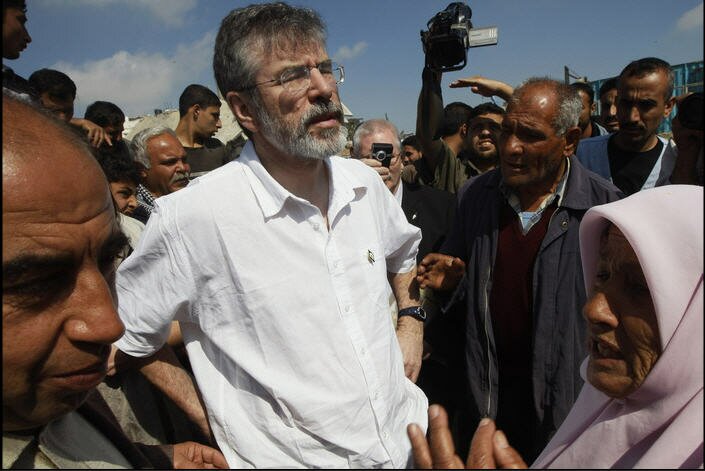
Sinn Féin leader Gerry Adams has urged Israelis and Palestinians to hold direct talks as he visited Gaza.
Mr Adams toured parts of northern Gaza devastated by the war that Israel waged in the Palestinian territory in early 2009.
Israeli officials are unhappy about Mr Adams' visit as he has not ruled out meeting officials from Hamas.
http://www.ardfheis.com/?p=1235
April 8, 2009 by sinnfein
Filed under Latest News
Sinn Féin President Gerry Adams this morning entered Gaza at the start of a two day visit to the area and part of a wider visit to Israel and the west Bank
Mr. Adams spent his first day in the region visiting Sderot and Kfar Aza – a town and Kibbutz – in southern Israel that have been the targets for rocket attacks from Gaza.
This morning he entered Gaza.
Speaking first in Irish to a packed press conference amid the rubble of buildings destroyed during the recent assault on Gaza by Israel Mr. Adams said:
The last time I visited this region was two and a half years ago. The conflict has been unrelenting since then.
My purpose in travelling to this region is to meet as wide a range of Israeli and Palestinian opinion as practicable; to listen to what they have to say; to learn more about the situation and to answer any questions they may have about the Irish peace process.
Yesterday I visited Sderot in southern Israel. This morning I am here.
The vast majority of Irish citizens who watched the Israeli assault unfold on Gaza before and after Christmas were shocked by what they saw.
They believe that what happened was wrong.
I too watched those scenes on TV but nothing prepares you for the reality of the destruction and the enormous impact this has had on people, on families and on children.
Sinn Fein and the majority of citizens in Ireland want all of this to end.
I believe there should be a complete cessation of all hostilities and freedom of movement for everyone.
There needs to be a dialogue between the people of Palestine and their leadership; and the people of Israel and their leadership; leading to a peace settlement which must be urgently built.
We believe that the people of Palestine and the people of Israel have the right to live free from the fear of threats, with human rights and in dignity and as equals.
And in as much as Sinn Fein can help we will.
The international community has a huge responsibility to use its influence to support a meaningful peace process that can deliver real change and hope for the people of Gaza.
I am convinced following my conversations and from my knowledge of this situation that the overwhelming majority of Palestinians and Israelis want peace and stability and a better future.” CRÍOCH
http://news.bbc.co.uk/2/hi/uk_news/northern_ireland/7990914.stm
A Sinn Fein councillor has been suspended from the party after a four-letter word outburst at a council meeting on Monday.
The party is investigating Padraig McShane's behaviour at a Moyle District Council meeting in Ballycastle.
He said he was angry at not being able to raise the proposed closure of a nursing home in the town.
He later apologised for his choice of words but said it was "an extremely emotive issue".
http://news.bbc.co.uk/go/pr/fr/-/2/hi/uk_news/northern_ireland/foyle_and_west/7989906.stm
Freya McClements
BBC News
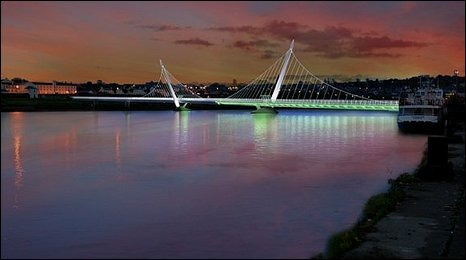
The physical, symbolic and emotional union of both sides of the city, and the economic regeneration of an entire area... just some of the hopes invested in the River Foyle's 'Peace Bridge'.
The £13.3m project will link the former Ebrington barracks site on the Waterside to the Guildhall Square on the Cityside.
The winning design - an S-shaped footbridge supported by two curved suspension structures linked to the opposite bank - was unveiled in Londonderry on Wednesday.
It is hoped the bridge will be the focus for not only major regeneration of the area, but the symbolic union of what was once a divided city.
Brenda Fraser from Ilex, the company charged with the economic regeneration of Derry, said these hopes were built into the bridge's design.
"The bridge is conceived as two distinct structural systems that work in harmony.
"It's a pair of identical curved suspension structures, each allied to opposing banks in a fluid arrangement.
"At the middle of the river the two structural systems don't just touch, they overlap, boldly interacting to create a single unified crossing.
“ A structural handshake across the Foyle and an embrace at the centre of the river ”
Brenda Fraser, Ilex
"It's a structural handshake across the Foyle and an embrace at the centre of the river," she said.
The Deputy First Minister, Martin McGuinness, who was at the launch, said it was the biggest single regeneration project in the city since the construction of the Foyle Bridge 30 years ago.
"This bridge can be a significant catalyst for change.
"It will transform our beautiful city and help transform the local community in the widest sense.
"When completed, the bridge will become a new regional landmark.
"It will be a symbol of a new beginning here in Derry City, creating a legacy for future generations," said Mr McGuinness.
"Of course, it's also important for the citizens of this city to see practical steps being taken and to see that the infrastructure is being put in place."
Work on the bridge is due to begin in September, with completion scheduled for October 2010.
The social development minister, Margaret Ritchie, said it would bring practical benefits to the people of Derry.
"There has been a need, and the recognition of that need, to both reintegrate the city centre as a whole with the river and to reinvigorate that centre.
"This new foot and cycle bridge will encourage all the citizens of Derry to have a sense of pride in their city and, just as importantly, to move safely through it.
"This, therefore, is bridge-building in both its literal and symbolic sense."
The head of the city's Chamber of Commerce, Jim Sammon, was equally optimistic.
"This is one of the biggest infrastructural investments in our city in recent times, and coming when it does it's physical proof of a commitment and a confidence in the development of Derry as a city and a region.
"It shows Derry is building, Derry is again building for the future."
High hopes, but can a footbridge deliver such positive results?
The mayor of Derry, Gerard Diver, believes it can.
"It may be just a bridge, but the symbolism of it won't be lost on people in terms of what it means.
"There is a real sense that this is a city that's going somewhere, that's developing, that's pulling itself up by its bootstraps.
"When you look at that artist's impression we're going to end up with something fairly amazing."
Story from BBC NEWS:
http://news.bbc.co.uk/go/pr/fr/-/2/hi/uk_news/northern_ireland/foyle_and_west/7989906.stm
Published: 2009/04/08 13:36:43 GMT
© BBC MMIX
http://www.irishecho.com/newspaper/story.cfm?id=19199
By Alana Fearon
April 8, 2009 The Irish government buried the Celtic Tiger era once and for all yesterday. In what was being described as the toughest budget in the history of the Irish state, finance minister Brian Lenihan outlined a series of tax hikes and spending cuts to the Dáil that will affect virtually every corner of Irish society.
It was the government's second budget in six months and its provisions will come into force on May 1.
Widely described as an "emergency" budget, it was prompted by the republic's fast contracting economy which has raised fears of out of control plummeting public finances and even more job losses.
And the fiscal pain might not be over yet as Lenihan pointed to other measures that might need to be implemented in the months ahead.
As budget day, a damp and dreary one, dawned, Taoiseach Brian Cowen's government faced the double challenge of dealing with a deepening recession while being forced to correct the biggest budget deficit in Europe.
Unemployment has already risen to almost 12 percent and government forecasts predict the budget deficit could reach four times the level that is legally allowed by the European Union.
For almost 20 years, economists have been praising the Irish republic as the economic model to follow, but the days of major foreign investments have ended and the purring of the Celtic Tiger has given way to an uneasy silence.
Lenihan admitted the emergency budget would not be easy on anyone, but vowed in advance that it would be fair. It certainly was wide ranging.
His budget doubled the current income and health levies at the various income levels they apply to, did away with the end of year social welfare bonus and reduced mortgage interest relief. Overall, the hardest hitting revenue raising measures were aimed at those with the highest incomes.
Lenihan told the Déil that the Irish taxation system was too narrowly applied. He said that too many people did not pay tax at all and there were too many ways in which those who had wealth could shelter their income.
He announced deep cuts in public spending including the cutting of hundreds of millions of euro from roads and public transportation projects. A planned underground Metro rail for Dublin, will, however, proceed.
Ireland's overseas aid budget, which has already fallen by €155 million over the last 18 months, is to be cut by a further €80 million, reflecting the fall in the country's gross domestic product.
No cuts in the basic social welfare rates will be made now, but Lenihan indicated that they may not be immune in the future. Childcare allowances will be cut, and there will be means testing for child benefits. Lenihan also alluded to possible future carbon and property taxes.
Taxes on the "old reliables" of alcohol, tobacco, gas and diesel have been included in the budget but the increases are lower than some in government wanted because of fears that excessive rises would spur cross-border trade and smuggling.
The government also directed cuts at itself. Pensions for sitting TDs are now out, while the number of junior ministers is being cut from 20 to 15.
Mortgage interest relief for owner-occupiers will only apply for the first seven years of a mortgage under new rules while the level of tax that investors can claim on residential rental properties will now only apply to 75 per cent of interest paid.
"What is wrong in our economy can be fixed if we take the right course of action now," Lenihan told the Dáil.
He pointed to six steps needed to restore the economy: stabilize public finances, restore the damaged banking system, boost exports, protect jobs and invest in retraining, support and stimulate economic confidence, and restore Ireland's reputation abroad.
Lenihan said the total tax and levies measures in the budget would raise €1.8 billion in 2009 and more than €3.6 billion in a full year.
This story appeared in the issue of April 8-14, 2009
http://news.bbc.co.uk/2/hi/business/7989407.stm
Ireland has had the debt ratings on all of its banks cut by Moody's, a day after revealing its emergency budget.
Finance Minister Brian Lenihan unveiled on Tuesday his decision to buy toxic debt from banks at a discount in exchange for government debt.
But the plan did not placate the ratings agency, who said it downgraded the 12 banks because the worsening economy would hurt bank profits anyway.
However, the European Commission said the budget was "decisive".
'Absolute urgency'
"The commission's preliminary assessment is that decisive, broad-based action has been taken in the supplementary budget, in very difficult economic circumstances," a commission spokesman said.
Before Brussels gave its backing, shares in Allied Irish Bank and Bank of Ireland both fell by about a third.
However, they later rallied. In early afternoon trade, Allied Irish was 20% lower and Bank of Ireland down 5%.
The Irish government said the Moody's downgrade showed the harsh reality that the Republic must do more to reassure international investors it was getting debt under control.
Foreign Minister Micheal Martin said the downgrade "underlines the absolute urgency and necessity to deal with this in a comprehensive and clear way".
He added: "The banks have been in denial that they have non-performing assets on their books."
Bond yields
The downgrades mean Moody's thinks it is more likely that all the banks will default on their debt, and makes it more expensive for them to borrow in the future.
Losses from the falling housing market and rising bad loans on their balance sheets will hurt the Irish banks, the agency added.
"We believe that these losses are likely to significantly weaken the capital positions of most Irish banks and building societies over the next two years," Moody's said.
Mr Lenihan's emergency budget on Tuesday included a large rise in taxes and a cut in spending, to deal with the Irish Republic's budget deficit.
Yields on the benchmark Irish debt have risen by more than one percentage point since the start of the year as investors have worried about the state of the Republic's public finances.
The rise means that investors want more compensation to hold the debt because they think there is more chance that the Irish Republic will default.
The increase also means its more expensive for the government to borrow and expand the public debt.
The yield on the Irish 10-year bond was 5.34%, up from 4.27% at the start of the year.
Story from BBC NEWS:
http://news.bbc.co.uk/go/pr/fr/-/2/hi/business/7989407.stm
Published: 2009/04/08 13:02:23 GMT
© BBC MMIX
http://www.eurosduvillage.eu/Jane-O-Mahony-The-Irish-realise,2516
6 mars 2009 | Par Jane O’MAHONY, Vera KISSLER
Interview with Jane O’Mahony, lecturer at the University of Kent and co-author of « Ireland and the European Union »
What were the reasons for the Irish No vote on the Lisbon Treaty in June 2008 ? Why was the No campaign so much stronger than the Yes campaign ? And will the Irish change their mind ?
Jane O’Mahony is lecturer in European Politics at the University of Kent. Previously, she was a Post-Doctoral Research Fellow at the University College Dublin. In her research she focuses on EU policy making and on Ireland’s relationship with the EU and she recently published a monograph on “Ireland and the European Union” together with Brigid Laffan.
The Euros : Ireland joined the EU with great enthusiasm in 1973 and since then membership helped the country to modernize and become known as the Celtic tiger. However, this economic miracle now turned into a deep crisis. How would you describe the general mood in Ireland right now ?
Jane O’Mahony : Very pessimistic. People realize the economic success of the Celtic tiger years are over and there is considerable worry about the future. Also, politicians are very much criticised in terms of their capacity to deal with the current economic situation facing the country.
The Euros : What is the attitude of the Irish towards the EU – and how has it changed over time ?
Jane O’Mahony : When Ireland joined the European Economic Community in 1973 a referendum was held in 1972 and it was overwhelmingly in favour of accession – 83% voted in favour, with a turnout of 70%. There was a little bit of a decline in support in the 1980s, partly because of the difficult economic situation domestically at the time. Particularly from the late 1980s and early 1990s, support for the Irish EU membership steadily increased to where, three or four years ago, it was, together with Luxembourg and the Netherlands, the highest in Eurobarometer polls – this is because the EU has meant good things for Ireland. There has been a very slight decline since then, but between the referendum on the Lisbon Treaty in June 2008 and now, there has been another shift evident in some opinion polls as people realize that Ireland cannot go it alone in the future.
The Euros : It seems to be a bit of a paradox that even at the time of the referendum on the Lisbon Treaty, 73% of the Irish actually said they were in favour of European integration. What were in your view the main reasons why the Irish rejected the Lisbon Treaty in June 2008 ?
Jane O’Mahony : Yes, we observed the same kind of paradox with the Dutch referendum in 2005. This leads you to think that the reasons why people voted No were not always related to the Treaty itself. But whereas it is quite easy to pinpoint the reason why the Irish rejected the Treaty of Nice in 2001 – a lack of knowledge – this is less obvious for the June 2008 referendum. 22% of those polled by telephone immediately after the vote said there was a lack of information. There was this very persuasive slogan “If you don’t know, vote No !”. Generally speaking, there was a climate of fear and also of anger against the government. But then, there is a myriad of other reasons. Some of them had nothing to do with Lisbon whatsoever. Some of them were domestic, some related to the loss of Irish identity and fears of a small state in an enlarged EU. The loss of the Irish Commissioner played a role, because in Irish politics there is a strong link between representatives and their constituency – for cultural reasons and also due to the electoral system of proportional representation by single transferable vote. Then there were other spurious issues that the government tried to address, but rather unsuccessfully, e.g. issues such as the Treaty of Lisbon would bring in gay marriage, euthanasia and abortion. The Libertas organisation was very effective in campaigning on the issue of corporation tax, which was seen as one of the key contributing elements to the Irish economic success of the Celtic tiger years. So there were plenty of reasons for the Irish No.
The Euros : Why was the No campaign so much stronger than the Yes campaign ?
Jane O’Mahony : Two things really. In Ireland the electorate is not very well informed about the European Union, as evidenced by objective and subjective knowledge indicators. Opponents to the treaty were able to cherry pick and attack various aspects of the Treaty, capitalising on voter ignorance. In the face of low levels of knowledge, voters believed these arguments as they tapped into their own fears for the future. At the same time, No campaigners ran very effective campaigns with a long lead-in time, that is to say, the Yes campaign took a long time to get going. Indeed, in some ways you had a sort of withdrawal of the political elites who wanted a Yes vote. They didn’t campaign, and when they did campaign, they were on the backfoot as they were always responding to points the No campaigners raised – and people just didn’t believe them. So there was this whole dynamic of the referendum. A political vacuum emerged in between the time the then Prime Minister Bertie Ahern stepped down as Prime Minister/Taoiseach and new Taoiseach Brian Cowen took over. So in the end you had a campaign of about three weeks, which is not enough to explain an admittedly complex Treaty. People thought they were being asked to take it on trust, but they were not prepared to take it on trust.
The Euros : Would you say Declan Ganley and his Libertas movement played a decisive role, which led to the No vote ?
Jane O’Mahony : Yes I would. Libertas ran a very effective campaign. Although Declan Ganley said he complied with all of the Standards in Public Office obligations relating to campaign spending etc., there were questions in the media about the money he put into the campaign, where it came from and how much was spent. Anecdotal estimates at the time said Libertas put 1.3 million Euros into it.
The Euros : Is it true that the Irish expected to get a “better deal” by voting No on the first occasion ? Does No really mean No in Irish referenda ?
Jane O’Mahony : Yes. Many in the electorate didn’t realise that there would be negative consequences for Ireland in voting against the Treaty. They had the experience of Nice where they could go back again to get a better deal or at least reassurances on certain matters. Campaigns in Ireland are conducted using considerable political postering and there was much more postering from the No side than from the Yes side, and posters from the No side were more provocative and visible. Sinn Fein in particular campaigned on the slogan “Vote No for a better deal”.
The Euros : What do you make of the concessions the Irish government negotiated after the No vote ?
Jane O’Mahony : The main substantive concession is the keeping of the Irish Commissioner. The other concessions that the Irish are currently negotiating relate to issues that have already been safeguarded by the Irish negotiators in successive treaty negotiations, such as neutrality. Even though the Irish Foreign Minister and others made a big effort to explain that Irish neutrality was safe already, that there was no issue of abortion being brought in or of the Irish tax system being changed, etc. people didn’t believe them. So the current declarations being negotiated by the Irish government and Irish diplomats should reassure the Irish electorate in a future referendum campaign.
The Euros : Taking all this into account, do you think the Irish will vote in favour of the Lisbon Treaty when they are asked for a second time ?
Jane O’Mahony : The signs are better than before. It was very clear early on in the Lisbon 1 campaign that a No vote was a distinct possibility. This time around, people realise they can’t go back, this is it now. If the Irish say No again, they stop the Treaty. And then it is all tied up with the economic situation. There is a huge dissatisfaction with the current government. But it is possible to argue that this may not affect the referendum in a negative way. One week before the Lisbon 1 referendum, opinion polls actually showed a high level of satisfaction with the government, so the connection is not obvious. The Lisbon 2 result will depend on whether the government runs a very effective campaign, together with the support of the majority of the remaining political parties. There will probably also be an element of “in or out”, i.e. of Ireland’s continued membership of the European Union, in the campaign itself as well. Even so, Libertas and other groups will campaign against the Treaty and they cannot be discounted.
The Euros : When will the second referendum take place ?
Jane O’Mahony : Some say the referendum should take place as soon as possible to put Ireland to a good standing within the EU. But I think the government wants to get through the local and European elections and then run the referendum in October.
The Euros : What do you expect to become the main issues in the campaign for the European Parliament elections in Ireland ?
Jane O’Mahony : It will be the economy I think. Traditionally, European elections are second order elections, so they are fought on national issues and not European ones. Declan Ganley wants to use it as a proxy for a referendum on the Lisbon Treaty across the EU. I don’t think that will happen in Ireland. It will be a vote of confidence in the current government, and they don’t expect to do well.
The Euros : Is Libertas credible as a pro-European party which opposes the Lisbon Treaty ?
Jane O’Mahony : Declan Ganley constantly re-iterates in the European media that he is pro-European. When you read what he says about the EU, he is critical of many aspects of the EU, which according to certain academic definitions, does constitute being eurosceptic. When you take his points to their logical conclusion, some of them are actually very advanced and would take the EU further towards a federalist direction. But then his main message is populist, he rails against European bureaucrats and doesn’t recognize that decisions in Brussels, especially in the Council, are taken by nationally-elected politicians. In addition, the people that he has surrounding himself, they generally tend to be critical of or dissenting voices to the EU.
The Euros : Provided the Irish say “Yes to Lisbon” later this year, will the Lisbon Treaty then pass ? Poland, Germany and the Czech Republic have not completed ratification so far either.
Jane O’Mahony : We cannot be sure, indeed. In the immediate aftermath of the referendum in June 2008 it seemed to be very clear that Ireland was going to be the only stumbling block, but now we have to wait and see how things will evolve in the Czech Republic and with the German Constitutional Court. But the Polish President said he would sign the Treaty once everybody else has done so.
The Euros : How will the Lisbon Treaty change the EU ?
Jane O’Mahony : Perhaps psychologically. It will be the end of a period of over eight years of wrangling over the institutions. People just want to get on with things and tackle the big issues that are currently facing the EU – with Lisbon they can do this, even if it is not a ‘big bang’ treaty. Lisbon will streamline decision-making, it will open up new priorities, such as climate change and energy, and psychologically it will allow the EU to move on after the failure of the Constitutional Treaty in 2005.
http://www.etaiwannews.com/etn/news_content.php?id=915408&lang=eng_news
By SHAWN POGATCHNIK
Associated Press
2009-04-09 12:39 AM
Ireland offered a potent symbolic concession Wednesday to Northern Ireland's Protestant community _ the right to bear Irish passports that say "Londonderry" instead of "Derry."
It might seem a small gesture. But for centuries, the proper name of the largest city in northwest Ireland has been among the most emotive sectarian irritants dividing Irish Catholic from British Protestant.
Catholics long aggrieved by the early 17th-century "plantation" of Scottish Protestant settlers in Ulster have insisted that city's proper name must remain its original Derry or Doire, Gaelic for "oak grove."
The Protestant commercial interests rechristened the city as Londonderry, and that remains the legal name today for Northern Ireland's second-largest, predominantly Catholic city.
Saying Derry or Londonderry is still one of the myriad cultural cues that locals today offer to indicate which side of the Northern Ireland divide they belong.
Until Wednesday, the Republic of Ireland gave Northern Ireland residents the right to passports _ but if you were a Protestant born in the city or county of Londonderry, you had to accept "Derry" as your only choice, to the annoyance of Protestant applicants.
But Foreign Minister Micheal Martin announced Wednesday that, from now on, Protestant sons and daughters of Londonderry will be permitted to acquire Irish harp-covered passports with their home city's preferred name in it.
Martin said the gesture was timed to highlight the 11th anniversary of the Good Friday peace accord, which the British and Irish governments and rival Northern Ireland parties achieved on April 10, 1998.
He noted that the landmark peace deal enshrined the right of Northern Ireland residents "to identify themselves and be accepted as Irish or British, or both, as they may so choose."
"I believe that for this birthright to be fulfilled, people of both traditions in Northern Ireland must be able to express their culture, language, and tradition in a climate of tolerance and mutual respect, free from discrimination or harassment," Martin said.
The disputed name of Derry/Londonderry _ also widely called "Stroke City" in recognition of that slash between the two _ has long presented a semantic test for visitors. During his 1995 visit to the city, former U.S. President Bill Clinton said he was pleased to be "in Derry and Londonderry," and later referred to the city as Derry but the surrounding county as Londonderry. He still managed to offend some Protestants by describing them all as Irish, though.
The city's overwhelmingly Catholic leaders have tried to take naming powers into their own hands, renaming their local government Derry City Council and their local runway the City of Derry Airport and suing the British government for the right to rename the city and county itself. But a Belfast judge ruled two years ago that the 1766 royal charter renaming Derry as Londonderry still applies.
The city's business interests seeking to appease both sides of the community often describe their home as "Foyle," referring to the river that cuts Derry/Londonderry into an overwhelmingly Catholic west side and largely Protestant east.
British passports _ with covers bearing the full national title of "United Kingdom of Great Britain and Northern Ireland" _ long have allowed Irish residents of Londonderry to register their home as "Derry."
Updated: 11/1/2009


Use the Guest Book to Comment on the web site or individual stories.
To get Irish News updates emailed to you