Irish Northern Aid
News


 |
||||


http://www.anphoblacht.com/news/detail/37981
‘Sunday Times’ H-Blocks story backfires
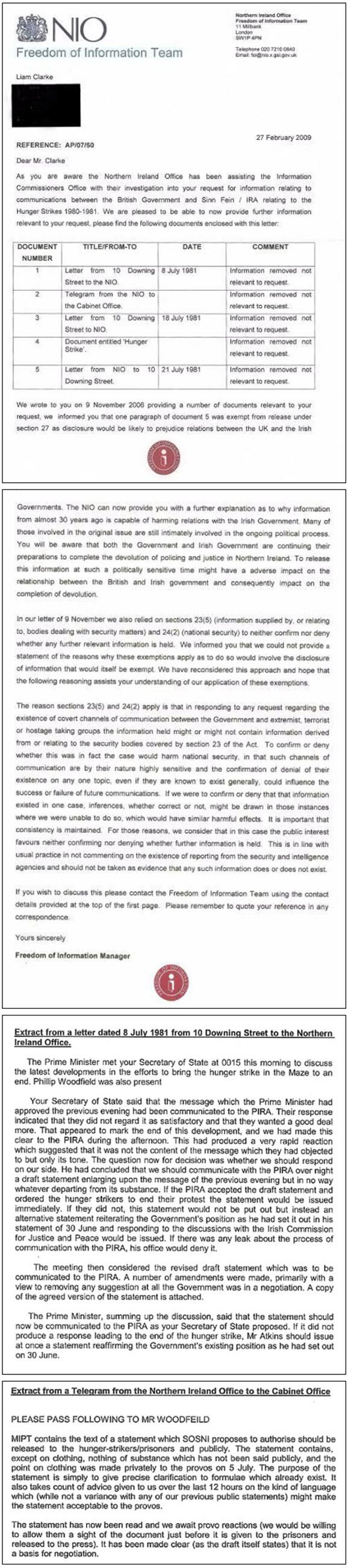
AN attempt by The Sunday Times last weekend (5 April) to call into question the republican leadership’s handling of the 1981 H-Blocks Hunger Strike by publishing British Government documents released under the Freedom of Information Act has actually boomeranged on the reporter who wrote the story, Liam Clarke.
[Liam Clarke, after being challenged by the Bobby Sands Trust, had to admit last month that a quote he attributed to Bobby Sands and used in a lurid headline – “Sinn Féin is turning into Sands’s dodo” – wasn’t said by Bobby Sands.]
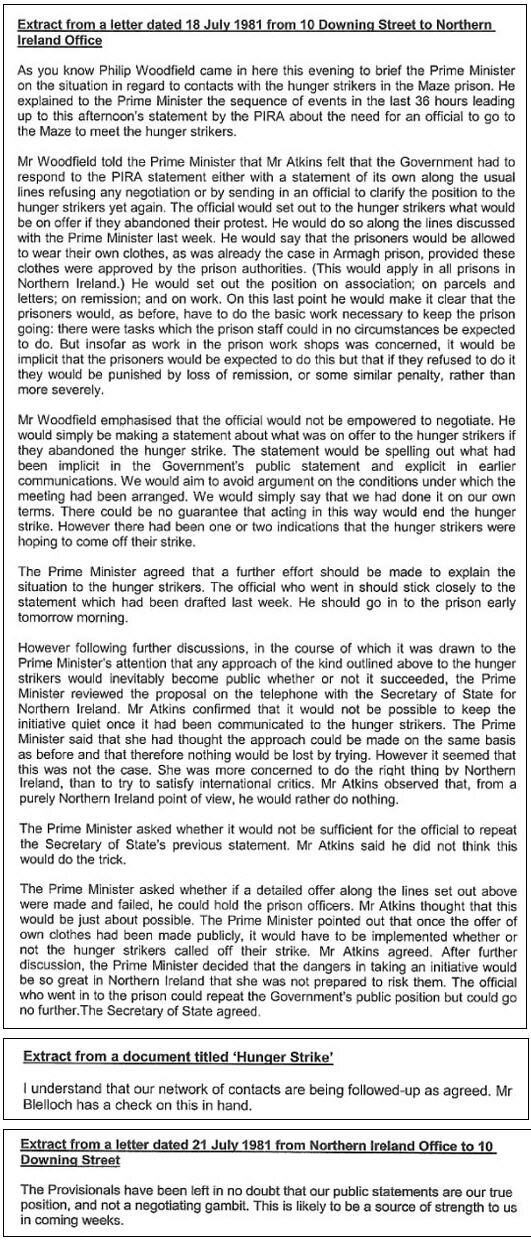
The British Government documents themselves, far from being incriminating, actually corroborate the account of what happened at the time by Sinn Féin, surviving Hunger Strikers, O/C Brendan McFarlane, the Irish Commission for Justice and Peace and detailed research by authors David Beresford, Padraig O’Malley and Denis O’Hearn.
[See documents at end of these articles – Editor.]
MISCHIEVOUS
Responding to Liam Clarke’s story, the secretary of the Bobby Sands Trust, Danny Morrison, who was the key contact between the prisoners and the Republican Movement during the Hunger Strike, issued the following statement:
“I welcome the release of documents by the British Government under the Freedom of Information Act, though I believe that their withholding of one or two particular documents is deliberate and mischievous.
“What is of interest is that a close reading of the documents supports not the sensationalist construction that The Sunday Times and others have put on them but what republicans have contended all along: that the British Government did not want a settlement on terms acceptable to the prisoners and that they played along with the delegation from the Irish Commission for Justice and Peace.
“It has been known for decades that the Republican Movement and the British were in contact in July 1981 during the Hunger Strike. As a result of that contact I went into the prison hospital on Sunday, July 5th, and told Joe McDonnell, Kevin Lynch, Kieran Doherty, Tom McElwee and Micky Devine, and told Brendan McFarlane, the leader of the prisoners, separately, that we were in contact and the details of what the British appeared to be offering in terms of the prisoners’ five demands.
“Because the prisoners at the end of the first Hunger Strike had experience of the British reneging on promised offers, and this reneging had led to the second Hunger Strike, the Hunger Strikers told me that they wanted a representative of the British Government to come in and stand over what was on offer. Now, what the British were offering fell short of the five demands but whether it would have been enough to end the Hunger Strike was never put to the test because the British refused to meet the Hunger Strikers and stand over their offer. So there was never a deal.
“Those people who criticise the leadership for faithfully representing and echoing the five demands of the prisoners and trying to maximise their gains, especially after four Hunger Strikers had laid down their lives, would in all likelihood be criticising the leadership if it had tried to force on the Hunger Strikers’ acceptance of just one concession or two concessions from the British.
“Among the documents still being withheld by the British are the one whose contents were delivered verbally through an intermediary on July 5th and which I delivered verbally to the Hunger Strikers and Brendan McFarlane; and the one which the British rewrote hours before Joe McDonnell died on July 8th but which neither we nor the Hunger Strikers were given. They rewrote it, according to the newly-released material, to alter its tone in response to a request, they say, by the Republican Movement. Crucially, if we accept this document then it indicates a Republican Movement anxious to settle, not prolong the Hunger Strike.
“The only reason the British could have for continuing to withhold this statement is simply to create and sustain confusion. These documents should be read alongside the timeline the Bobby Sands Trust has detailed. These documents also tally with a background interview from 1986 with a senior prison official, Sir John Blelloch, which he did not anticipate being published but which the Trust released a few weeks ago.
“In that interview Blelloch states: ‘There was absolutely no change in the Government’s position.’
“The documents in the The Sunday Times say: ‘The statement [the one still withheld] contains, except on clothing, nothing of substance which has not been said publicly... It has been made clear (as the draft itself states) that it is not a basis for negotiation.’
“This was the real position of the British Government and it is being lost among sensational claims which, unfortunately, are bound to cause pain to the families of the Hunger Strikers.”
Allegations 'false and without any substance' – Sinn Féin
SINN FÉIN said the claims in The Sunday Times were “nothing new” and have been “comprehensively refuted, both by documentary evidence and witness testimony, when they first appeared in Richard O’Rawe’s book some year ago.”
A Sinn Féin spokesperson described the allegations as “false and without any substance”, adding:
“Indeed, all of the documents, including those published in the Sunday Times, point clearly to a republican leadership seeking to find a resolution and a British side seeking a victory over the prisoners.”
The spokesperson said these include the recent discovery and publication by the Bobby Sands Trust of a previously unpublished interview with Sir John Blelloch, a member of MI5 who had been seconded to the NIO as a Deputy Secretary at the time of the 1980 and 1981 Hunger Strikes (see ‘Timeline’ on facing page and, for the full interview with Blelloch www.bobbysandstrust.com/archives/1069).
The Sinn Féin representative ended by saying:
“If people study the documentary evidence and follow the actual timeline of events then these allegations are exposed for what they are and show clearly where the truth of this matter lies.”
Francis Hughes’s family speaks out
Oliver HughesTHE family of Francis Hughes, the second Hunger Striker to die in 1981, have responded to the Sunday Times story. Speaking through Oliver Hughes, they said:
“We came through that terrible year of 1981 and all the years afterwards supported by our memory of Francis, a young Irishman of whom we remain very, very proud.
“In recent years we have read various accounts of the Hunger Strike and talk of negotiations and offers. We know who it was that took away Special Category status, who it was beat the prisoners, who it was caused the Hunger Strike and refused to do a deal which at the time would have saved lives.
“That was 28 years ago but still there are those who, for whatever reason, bring up the past in a way that puts us through more pain and distress. If they are really concerned about how this one family of a Hunger Striker feels then I would ask them to put the issue to rest.” – Oliver Hughes
Timeline around Joe McDonnell’s death, 1981 H-Block Hunger Strike
29 June 1981: Four hunger strikers have already died: Bobby Sands on Day 66, Francis Hughes on Day 59, Raymond McCreesh and Patsy O’Hara on Day 61 of their hunger strikes.
Joe McDonnell is on Day 52 without food. NIO Secretary of State Humphrey Atkins reaffirms that political status will not be granted and that implementing changes in the areas of work, clothing and association present “great difficulty” and would only encourage the prisoners to believe that they could achieve status through “the so-called ‘five demands’”.
3 July: Irish Commission for Justice and Peace (ICJP) has eight-hour meeting with Prisons Minister Michael Alison.
4 July: ICJP again meets Alison and they meet the eight Hunger Strikers in the prison hospital. They are shocked at the condition of Joe McDonnell. Prisoners later issue statement saying British Government could settle the Hunger Strike without any departure from “principle” by extending prison reforms to the entire prison population. ICJP tells prisoners’ families they are “hopeful” but that prisoners deeply distrust the authorities.
British Government representative (codenamed ‘Mountain Climber’) secretly contacts republican leadership by ‘back channel’. Insists on strict confidentiality.
5 July: After exchanges, Mountain Climber’s offer (concessions in relation to aspects of the five demands) goes further than ICJP’s understanding of Government position. Sinn Féin’s Danny Morrison is allowed (on a Sunday) to visit Hunger Strikers in prison hospital and updates them on all developments. Separately, he meets prison O/C Brendan McFarlane and explains what Mountain Climber is offering should Hunger Strike be terminated. McFarlane meets Hunger Strikers. Morrison is allowed to phone out from the doctor’s surgery. Tells Gerry Adams that prisoners will not take anything on trust, and prisoners want offers confirmed and seek to improve them. While waiting for McFarlane to return, Morrison is ordered out of the prison by a governor, John Pepper.
ICJP visits Hunger Strikers and offer themselves as mediators. Hunger Strikers say they want NIO rep to talk directly to them. Request by Hunger Strikers to meet McFarlane with ICJP is refused by NIO. Mountain Climber is told that prisoners want any offer verified.
6 July: Gerry Adams confides in ICJP about secret contact and the difference in the offers. ICJP is stunned by disclosure. It confronts Alison and demands that a guarantor goes into the jail and confirms what is on offer. Alison checks with his superiors and states that a guarantor will go in at 9am the following morning, Tuesday 7 July. Hunger Strikers are told to expect an official from the NIO.
7 July: Republican monitors await response from Mountain Climber.
- 11.40am: Bishop O’Mahoney (ICJP) telephones Alison, asking where the guarantor is. Alison suggests he and the ICJP have another meeting. O’Mahoney tells him he is shocked, dismayed and amazed that the Government should be continuing with its game of brinkmanship. The bishop says: “I beg you to get someone into prison and get things started.”
- 12.18pm: ICJP decides to hold 1pm press conference outlining what had been agreed by the Government and explain how the British had failed to honour it.
- 12.55pm: NIO phones ICJP and says that an official would meet the Hunger Strikers that afternoon.
- 1pm: ICJP calls off its press conference.
- Late afternoon: Statement from PRO, H-Blocks, Richard O’Rawe: “We are very depressed at the fact that our comrade, Joe McDonnell, is virtually on the brink of death, especially when the solution to the issue is there for the taking. The urgency of the situation dictates that the British act on our statement of July 4 now.”
- 4pm: NIO tells ICJP that an official will be going in but that the document was still being drafted.
- 5.55pm: ICJP phones Alison and expresses concern that no official has gone in.
- 7.15pm: ICJP phones Alison and again expresses concern.
- 8.50pm: NIO tells ICJP that the official will be going in shortly.
- 10pm: Alison tells ICJP that no one would be going in that night but would at 7.30am the next morning and claims that the delay would be to the benefit of the prisoners. Republican monitors still waiting confirmation from Mountain Climber that an NIO representative will meet the Hunger Strikers. The call does not come.
8 July
- 4.50am Joe McDonnell dies on the 61st day of his hunger strike.
- 9am: An NIO official visits each Hunger Striker in his cell and reads out a statement which says that nothing has changed since Humphrey Atkins’s policy statement of 29 June.
ICJP holds press conference and condemns British Government and NIO for failing to honour undertaking and for “clawing back” concessions.
Late afternoon: Statement from PRO, H-Blocks, Richard O’Rawe: “The British Government’s hypocrisy and their refusal to act in a responsible manner are completely to blame for the death of Joe McDonnell. The only definite response forthcoming from the British Government is the death of Joe McDonnell. This morning, Mr Atkins has issued us with yet another ambiguous and self-gratifying statement. That statement, even given its most optimistic reading, is far removed from our July 4 statement. At face value it amounts to nothing.”
10 July: ICJP leaves Belfast.
Prisons Minister Michael Alison flies to Washington, DC. He blames the breakdown on the ICJP’s “over-eagerness” and says they had misrepresented what he had said, inflating his “privately expressed sentiments” to suggest that a solution was near. Its proposals to the British Government were “wildly euphoric and wildly out of perspective”, he says. He compares talking to Hunger Strikers as like talking to hijackers: “You continued talking while you figured out a way to defeat them, while allowing them to save face.”
23 July: Late afternoon: Statement from PRO, H-Blocks, Richard O’Rawe: “The [ICJP’s] proposals were vague but even at that we did not believe they contained a just settlement. After Joe McDonnell’s death on July 8th the British Government issued their present policy statement which in substance and even given an optimistic reading was a dilution of the diluted package attained initially by the ICJP.
“It is vital also that everyone realises that the ICJP have been victims of British perfidity [sic] and that the ambiguity which accompanies all British statements is deliberate...
“The death of our comrade Joe McDonnell on July 8th, plus the Humphrey Atkins statement of the same day, and the evolution of bitter claim and counter-claim between the British and the ICJP left one thing clear – that intermediaries (and this is no slight on the ICJP), are dangerous and that only direct talks between the British and ourselves based on our 4th July statement can guarantee clarity and sincerity and thus save lives.”
In relation to a very late intervention by the Red Cross at the invitation of the British, in the same statement the PRO wrote: “They [the British] hoped to brinkmanship us in a mediating situation, hoping that we would accept a cosmetic settlement...”
He accused the British Government of having “no intention of genuinely ending the hunger strike...
“At present, the British are looking for what amounts to an absolute surrender. They are offering us nothing that amounts to an honourable solution and they have created red herrings, that is, their refusal to allow Brendan McFarlane to represent the Hunger Strikers, to cover their inflexibility...
“Lastly, we hope that it is clear that we cannot end the Hunger Strike unless justice is done and that ultimately lies in the hands of the Brits.”
8 August: Death of Tom McElwee.
Late afternoon: Statement from PRO, H-Blocks, Richard O’Rawe, attacking Humphrey Atkins:
“For a man to claim he has stated his position clearly in relation to ‘what will happen when the protest ends’, despite the fact that no one really knows what is on offer, shows the insensitivity/insanity of his position and policy.
“We suggest that he won’t outline his policy because: No 1, he hopes to about turn – at some time; and No 2, he knows he is offering so little that even moderate opinion would be insulted...
“Very much prominent in their [British] thinking is the belief that, sooner or later, we are going to pack up and give in. They have a rude awakening awaiting them.”
2009
Bobby Sands Trust releases unpublished interview from 1986 with Sir John Blelloch, a member of MI5 who had been seconded to the NIO as a Deputy Secretary at the time of the 1980 and 1981 Hunger Strikes. It is an insight into the psyche of the British at crucial periods in the Hunger Strikes, particularly at the time of mediation attempts by others, including the ICJP. Blelloch states: “There was absolutely no change in the [British] Government’s position.”
Full interview – http://www.bobbysandstrust.com/archives/1069
Articles may not be reproduced without the consent of An Phoblacht. For further information, please contact
http://www.telegraph.co.uk/news/uknews/northernireland/5136853/Northern-Ireland-police-need-armoured-vehicles.html
Sir Hugh Orde has called for the police in Northern Ireland to be given armoured cars amid fears of a return to the days of sectarian violence.
By Auslan Cramb, Scottish Correspondent
Last Updated: 5:09PM BST 10 Apr 2009
Following the murders last month of two soldiers and one police officer, the Chief Constable of the Police Service of Northern Ireland said he did not believe the IRA was coming back but admitted that "a few lunatics with guns can cause real damage".
He said the risk was increased because there was no longer a "huge military capacity" in the province. There have been no army patrols since July 2007 when Operation Banner, the military's 38-year deployment in support of the police, officially ended.
The withdrawal of patrols has coincided with the transfer of police officers from armoured Land Rovers into "soft skinned vehicles" and a reduction in check points.
Sir Hugh is stepping down as chief constable and will learn later this month if he is to become the next president of the Association of Chief Police Officers. However, he said he was not "demob happy" and was preoccupied with the dissident groups that carried out the recent killings.
Earlier this week Belfast was hit by a spate of burnings and hoax bomb alerts, supposedly in protest at the detention of men suspected of the murders of Sappers Mark Quinsey, and Patrick Azimkar in Antrim, and Constable Stephen Carroll in Craigavon.
He added: "Is this the IRA coming back? No, they are not in that league, but a few lunatics with guns can cause real damage, especially since we don't have the huge military capacity anymore."
In the absence of army air cover he said he would like a second PSNI helicopter to provide selective support for ground patrols. He also wants armoured cars that "look less military" than the reserve fleet of ageing Land Rovers.
"If new vehicles can keep one cop alive it is worth doing, it is a question of when you start building up your capacity," he said. "We can go back to Land Rovers but that is not where we want to be. I think the Government will be sympathetic and helpful."
Reflecting on his seven years as chief constable, he said he had a "whacky" moment last month while standing beside Martin McGuinness, the Deputy First Minister - and a former IRA leader - listening to him denounce those who attacked the British soldiers as "traitors" and call for information to be given to the police.
Sir Hugh said the objective of the Continuity IRA (CIRA) and the Real IRA (RIRA) was to "get the Army out on the streets so they have an excuse to spend the next 30 years saying there are fighting to get them off the streets again". "I have no intention of obliging them," he added.
http://www.larnetimes.co.uk/news/CRIMSON-AND-ORANGE--TO.5150655.jp
Published Date: 09 April 2009
By Staff reporter
TWO major parades takes place in Larne this Easter - traditionally the start of the marching season.
An Apprentice Boys of Derry demonstration on Monday will be one of the biggest to be organised in the town, with members from all over Northern Ireland and Scotland taking part. And junior members of the Orange Order will parade the next day.
It is the turn of the Scottish Amalgamated Committee to organise the Apprentice Boys’ annual Easter demonstration and they have chosen Larne as the venue.
With assistance from the Larne Walker Club, formed some 12 years ago, the Scottish brethren have received indications from some 55 Apprentice Boys clubs - comprising some 5,000 members - that they intend to take part.
Many will be on the road from as early as 9am and at Noon a small parade, led by two bands, will march to the cenotaph for a wreath-laying ceremony.
The main parade assembles at Sandy Bay at 12.45pm and is scheduled to move off on the hour, headed by Scottish dignitaries and president of the Larne Walker Club, Wesley McClure.
The route is along Rugby Road, Chaine Memorial Road, Bay Road, Curran Road, Glenarm Road, Newington Avenue, Herbert Avenue, Agnew Street, Main Street, Upper Main Street, Bridge Street, Glynn Road, Circular Road, Narrow Gauge Road and concluding at Point Street.
Apprentice Boys’ governor James Brownlee will watch from a saluting base at the corner of Glynn Road and Circular Road.
Marchers have been urged; “Wearing of the colour crimson is requested and enjoy the day.”
Meanwhile on Easter Tuesday, around 900 members of the Belfast Junior County Lodge will be in Larne, along with an expected 15 bands and hundreds of supporters.
They will assemble at Station Road for their parade to Sandy Bay, setting off at 12.10pm.
The route will take in Bridge Street, High Street, Upper Main Street, Main Street, Curran Road and Bay Park.
The starting time of the return parade is 3.30pm, along the same route back to Station Road.
http://www.irishtimes.com/newspaper/breaking/2009/0410/breaking39.htm
Fri, Apr 10, 2009
The Cabinet has approved legislation granting the gardaí new powers which will allow them to break into criminals' houses, plant audio and visual bugging devices and use the material gathered to prosecute gang members in court.
Speaking today, the Minister for Defence Willie O’Dea said the covert surveillance legislation was approved by the Cabinet earlier this week.
He said: “There are a few things the attorney general has to sign off on yet but it is at a very advanced stage.”
The measures contained in the Covert Surveillance Bill were promised by the Government in the wake of the murder of Shane Geoghegan in Limerick last November.
Mr O’Dea said the new measures would be “a powerful weapon in the arsenal of the gardaí.”
Speaking after the murder yesterday of 35-year-old father of two Roy Collins in Limerick he said “the climate of fear and intimidation” in the city “has to be seen to be experienced”.
The Minister said that although he has faith in the gardaí catching the perpetrators of murders in the city the people behind the scenes giving the orders are “the people who must now be targeted”.
He said the Government hopes the new legislation will act as corroboration to enable gardaí “to put those people away”.
Under the new provisions, gardaí can apply to the courts to plant bugging devices for three months. In emergency cases a device can be planted on the permission of a chief superintendent. In those cases, the device can only be used for 14 days. The emergency provision will only be used if gardaí believe a criminal is about to abscond, destroy evidence or intimidate a witness.
Devices can only be used in the investigation of arrestable offences carrying jail terms of five years or more.
All cases will be reviewed annually by a High Court judge, who will prepare an annual report for the Taoiseach. The Taoiseach can exclude sensitive cases from the judge's report before publication.
When covert evidence is presented in court, a Garda witness will not be obliged to disclose the methods surrounding the planting of a device.
© 2009 irishtimes.com
http://www.rte.ie/news/2009/0410/belfast2.html
Friday, 10 April 2009 17:53
More than 40 foreign nationals are believed to have fled their homes in Belfast following intimidation in the wake of last month's World Cup qualifier game between Northern Ireland and Poland.
Four Polish supporters were charged following violent clashes between rival fans across the city.
Police say that the majority of Polish fans lived outside Northern Ireland but as they returned home, others bore the brunt.
It is understood that the homes of some foreign nationals living in the largely loyalist Village area of South Belfast came under attack in the immediate aftermath of the match.
Since then, it is claimed that over 40 foreign nationals have fled the area with five having left Northern Ireland for good.
The North's Housing Executive has confirmed that so far eight people have presented themselves as homeless following trouble in the area.
It is hoped that greater integration between residents will ease tensions and prevent future violence.
http://news.bbc.co.uk/2/hi/uk_news/northern_ireland/foyle_and_west/7994002.stm
Environmental health officers have been asked to force the owner of the former Tillie and Henderson factory to clean up the vacant site.
Sinn Fein councillor Maeve McLaughlin requested that Derry City Council make the owner, Lord Diljit Rana, clean it up or start build on the site.
Ms McLaughlin said the former factory is a dangerous eyesore and a focus for anti-social behaviour.
Lord Rana said he had longstanding plans to develop the site.
"Just because the site is there doesn't mean it encourages anti-social behaviour.
"Our architect is in constant touch with the local authorities and with planners, and we are planning a comprehensive development," he said.
Story from BBC NEWS:
http://news.bbc.co.uk/go/pr/fr/-/2/hi/uk_news/northern_ireland/foyle_and_west/7994002.stm
Published: 2009/04/10 14:43:05 GMT
© BBC MMIX
http://news.bbc.co.uk/2/hi/uk_news/northern_ireland/7994015.stm
A Northern Ireland-based army unit has taken command in Helmand in southern Afghanistan.
This is the first time 19 Light Brigade - which has about 3,000 troops normally stationed in NI, has provided the bulk of the UK force in Afghanistan.
The units are based at Lisburn, Ballykinler, Holywood and Antrim.
Brigadier Tim Radford said that they were "well prepared" for the challenges ahead.
"We are very well prepared for the myriad challenges that we face and through the provision of security, stability and reconstruction we will undermine the insurgents, help to expand governance and improve the day to day lives of the Afghan people," he said.
19 LIGHT BRIGADE
- Headquarters and Signal (209) - Lisburn
- 40th Royal Artillery - Lisburn
- 38 Engineer Regiment - Antrim
- 2nd Battalion, The Mercian Regiment - Holywood
- 2nd Battalion, The Rifles - Ballykinler
- 173 Provost Company Royal Military Police - Lisburn
- The Light Dragoons - Norfolk
- 1st Battalion, The Welsh Guards - Aldershot
- The Black Watch, 3rd Battalion - Inverness
- 2nd Battalion, The Royal Regiment of Fusiliers - Hounslow
The flag of 19 Light Brigade replaced that of 3 Commando Brigade in the task force headquarters in Lashkar Gah.
The Commander of 3 Commando Brigade, Brigadier Gordon Messenger said they had "made a real difference to the security and wellbeing of southern Afghanistan".
"We will never forget those who have been killed or injured on our watch but as we reflect on the last six months the overriding feeling of 3 Commando Brigade is one of pride and satisfaction at a job well done," he said.
The UK currently has some 8,000 troops serving in the country, most of them in the southern province of Helmand.
Prime Minister Gordon Brown has offered to send more British troops to serve on operations in Afghanistan.
The troops would be sent to provide security ahead of the country's presidential elections in August.
Story from BBC NEWS:
http://news.bbc.co.uk/go/pr/fr/-/2/hi/uk_news/northern_ireland/7994015.stm
Published: 2009/04/10 14:24:03 GMT
© BBC MMIX
http://beara.ie/index.php?option=com_content&task=view&id=122&Itemid=1
Written by Dave
Thursday, 09 April 2009
Bantry General Hospital has cared well for the people of West Cork and South Kerry. The proposed budgetary cuts means it is set to lose its 24-hour acute services. Currently 70% of admissions to the hospital are emergencies and outside 'office' hours.
If the proposed cuts are implemented anyone with a medical emergency outside hours may have to endure a dash to Cork by road. This is a journey, of up to 100 miles, takes about two and a half hours on the roads of West Cork.
Bantry Hospital has been an absolute lifeline to many people. Soon that lifeline will be severed. Are our lives so cheap? This potentially affects everyone in Beara, so please raise your voice by attending the rally in Castletownbere.
The protest rally is in the main square in Castletownbere on Easter Saturday 11th April at 12 noon
Please also consider signing the Friends of Bantry Hospital petition which is available in most Post Offices and shops in the Beara area or sign here on line and the names will be added.
http://www.uup.org/newsrooms/latest-news/general/tackling-cross-border-crime.php
Ulster Unionist MLA, Tom Elliott, has called on members of the community to bring forward any information they have regarding cross-border criminality to police, as national authorities continue to clamp down on illegal activity. Since the beginning of the peace process and the creation of a relaxed land border between Northern Ireland and the Republic, criminal gangs have used the difference in the jurisdictions to their advantage. Their activities include the smuggling of drugs, weapons, fuel, cigarettes and even in some cases immigrants, often from Eastern European countries.
Mr Elliott, whose constituency of Fermanagh and South Tyrone shares a large portion of the border with the Republic, said that those who seek to use the divide for criminal gain must be caught and face justice.
He said: "Cross border crime in not a new phenomenon, but it is one that has got considerably worse in recent years. Throughout the troubles, people in border areas knew that there were criminals, often terrorists, working on both sides of the divide, often in localised crime rackets. Now however, since the beginning of the peace process and the relaxation of security along the border it is clear that a new international element to crime has evolved. This has seen the development of increasingly sophisticated methods of crime coupled with a dramatic rise in the value of goods being smuggled. For example, while fuel laundering is a crime that has existed for many years, the smuggling of immigrants, or people-trafficking as it known, has become a very serious issue. Indeed, many female individuals who are trafficked into Northern Ireland are then forced into the sex trade, are often abused and can become addicted to drugs. It is a sickening crime and just one example of the new type of criminality which the Serious Organised Crime Agency (SOCA) are having to tackle."
Noting that intelligence indicates that many of the criminals using the border are current or former paramilitaries, Mr Elliott said that it was incredibly ironic that those who used to pretend Ireland was a single country and murder for this ideology now used the border to further their ill-gotten gains, at the expense of the both states.
He went on to say: "I find it very ironic that we now have former terrorists who used the existence of the border as justification to murder innocent people now using the very same border to line their pockets and steal from the people of both Northern Ireland and the Republic. That is not to say that loyalist paramilitaries are not involved in cross border criminality as well, and indeed I think it is important to remember that terrorists, no matter what side they claim to represent, are scum who are only heroes to themselves in their warped minds. Crime is a degenerate activity perpetrated by individuals who are only out for themselves and those involved don't care about this place or the people in it, but only about the amount of money they can make and the number of lives they can destroy."
"I am aware that SOCA and the PSNI, in conjunction with the Garda in the Republic, are doing their utmost to catch criminal gangs along the border and bring them to justice. It is vitally important that we as a community support them in this aim and provide any information we can to aid their investigations. This is why I am calling on anyone who has information or who witnesses any suspicious behaviour in border areas to contact the authorities immediately. It is only by working together that we can halt this growing wave of criminality and ensure that those behind it are sent to prison where they belong."
http://www.themilitant.com/2009/7315/731502.html
BY PAUL DAVIES
BELFAST, Northern Ireland—Workers occupied the Visteon auto parts plant here March 31 when company managers informed them that the plant would close that day. The following day workers occupied Visteon’s plant in Enfield and have kept up a protest outside another plant in Basildon—both just outside London. The workers are represented by the UNITE union.
Visteon UK was established in 2000 from existing Ford car parts plants. The company manufactured fuel rails, injection moldings, and other parts used in Ford’s operations. Production will be moved to Visteon plants elsewhere in the world.
“We’re demanding that the factory stay open, if not then Ford must honor their obligations to workers being laid off and make redundancy [severance] payments in full,” explained John Maguire, the UNITE convener at the Visteon Belfast car parts plant.
Rick Pineda, a worker at the Belfast plant for 11 years, stated, “We weren’t prepared, but when it came to it we didn’t just accept losing our jobs. Nobody moved off the plant. We don’t accept that Ford can use us and dispose of us.”
Patrick Logan, a production worker at the company for 12 years and a shop steward, said, “We wouldn’t let the shift-change security enter the plant and the next morning after working a double shift the remaining security guards left. Management were let out at 7:00 p.m. to a few jeers.” The company-appointed administrators, KMPG, left the following day. KMPG, which the company chose to run all three plants, immediately shut down production and announced that 560 jobs were being cut.
‘We won’t be letting them back in’
“We won’t be letting them back in,” Logan noted. He said that workers had established different teams to organize catering and cleaning of the plant and the surrounding area. The workers organize three shifts for the around-the-clock occupation and hold update meetings daily.
At the Enfield plant in north London, workers were given six minutes’ notice of the plant’s closure. “We went home and then heard that the Belfast Visteon workers had occupied, so we went back to the factory the next day and did the same,” said Phil Wilson a worker at the plant for 17 years. Initially, only 70 workers were able to get access to the factory. Ron Clark, the plant’s deputy convener, explained, “We’ve found ways to get others in.”
Now more than 100 are part of the occupation, while other workers bring food and drinks to those inside the factory. “Our spirits are high. There are people I didn’t expect to see in this kind of struggle, fighting together,” commented Wilson.
As the Militant goes to press, the Financial Times reported that a judge had ordered the eviction of workers from the Enfield plant April 9. Visteon workers appealed to other unionists to turn out that day to show support. A meeting between Visteon and the union was scheduled for April 8.
Scott Edmonds, a shop steward at the Basildon plant, said that since April 1 workers there have organized a picket at both plant entrances 24 hours a day. Motorists honk horns to show their support.
Some of the Basildon workers visited the Enfield site on April 4. The following day a banner was hung at the Belfast plant that read: “Belfast Supports Enfield’s Kevin Nolan.” The banner refers to a court order issued against Nolan, the union’s Enfield plant convener.
The workers in Belfast have received support from Members of Parliament, Gerry Adams of Sinn Fein, and Jeffrey Donaldson of the Democratic Unionist Party. Adams addressed a meeting of workers and their relatives in the plant canteen on April 5. Robbie Williams, a steward at the Ford plant at Bridgend, South Wales, and Jimmy Kelly, regional secretary of UNITE, also spoke. Workers at the Waterford Crystal plant in the Republic of Ireland sent a donation of 5,000 euros (US$6,630) to the unionists at the Visteon plant.
Workers at the Belfast plant described the different redundancy terms and conditions that result if Visteon declares bankruptcy, rather than the terms agreed to when the plant was established by Ford. Logan said, “They disregarded the 90 days consultation after announcing redundancies—that would be a further 12 weeks’ pay. Ford had redundancy payments based on the number of years worked. We will get the statutory minimum, thousands of pounds less. The government will now administer the pension fund. There are no guarantees for the workers.”
An article published in the Sunday Times April 5 noted that Ford had promised workers that their terms and conditions would remain for a “lifetime” if they worked at Visteon.
Further layoffs have recently been announced in Belfast, with just under 1,000 workers losing their jobs at aircraft manufacturer Bombardier. Among them the jobs of all 665 temporary workers are being eliminated. “There will be no redundancy package for the temps,” said Simon Lynch, a fabricator at the plant. “And there are no similar jobs to go to in Belfast.”
ólöf Andra Proppe, Ögmundur Jónsson, and Björn Tirsén contributed to this article.
http://www.breakingnews.ie/ireland/eyaugbmhauid/rss2/
10/04/2009 - 17:00:47
Ford showrooms in Belfast are to be picketed in an escalation of the Visteon dispute, a workers’ spokesman said today.
Tomorrow morning’s action is despite union efforts to prevent the move after hopes of progress in redundancy negotiations.
Around 210 workers were laid off in the North 10 days ago after a decision to close the three loss-making Visteon UK car component plants. Protesters want their contracts honoured with former owner Ford.
A spokesman for the disgruntled former staff said: “We expect around 20 people to take part in pickets in the morning. It is a measure of how strongly we feel. We plan to picket two or three showrooms.”
Ford sold the car components part of its business in 2000. It had offered former employees the chance to return to the fold but denied having any remaining responsibilities to the Visteon workers.
Employees in west Belfast have staged a sit-in since they were dismissed. Visteon centres in Basildon, Essex, and Enfield, north London, have also been closed and workers there are demonstrating.
Unite union national leaders have been to New York for talks with Visteon management and were due to brief colleagues in Belfast this week after expressing optimism about future talks.
A rally was held earlier this week in Belfast with several hundred listening to Irish union leaders.
The North’s manufacturing had suffered its bleakest week for some time with an additional 975 voluntary redundancies announced at Bombardier aerospace factory in east Belfast, among others.
Visteon has been losing millions of pounds in the UK, with its US headquarters forced to subsidise it amid a global downturn in demand for new cars.
http://viigo.im/hiA
By John Murray Brown
Published: April 10 2009 18:31 | Last updated: April 10 2009 18:31
Hundreds of Irish rugby fans who were due to travel to London on Sunday for a crucial European cup tie have returned their tickets in a sign of how Ireland’s biting recession is hitting middleclass professionals.
The lengthening dole queues and the grounded helicopters of Ireland’s bankrupt property developers may be the common leitmotif for Ireland’s current economic plight.
But it is the suffering of the middle class – and few groups better epitomise this than loyal travelling rugby fans – that makes this downturn different.
This week’s budget saw Brian Lenihan, finance minister, slap new income and health taxes on middle and higher income families as he sought to contain ballooning public borrowing and stave off economic collapse.
But he got an early foretaste of the chattering classes’ anger when he took questions in his traditional post-budget phone-in on RTE, the state broadcaster.
“I will become a criminal rather than pay you any more tax,” said Carol O’Byrne, a 51-year teacher earning €63,000 ($82,800, £56,600) who predicted she would lose €900 a month.
The minister’s riposte was that everyone must share the pain. But this did not cut much ice with Mrs O’Byrne, frustrated that hardworking families like hers were an easy political target while others are “scamming social welfare and pretending to go to college”.
Mr Lenihan’s problem is that he is anxious to avoid political protests, which ministers fear could add to international investor nerves at a time when Ireland’s creditworthiness is being questioned by the markets.
The main budget in October, when he cut the automatic right of the elderly to a medical card, saw thousands of pensioners descend on the Dáil, the Irish parliament.
In January, in his second stab at correcting the public finances, the introduction of a levy on the pensions of the country’s 350,000 public servants triggered the largest public protest Dublin has seen in 30 years.
There will not be much sympathy for the developers and builders, which are now facing bankruptcy as land values plummet and housing estates stand empty or half finished. But many professions have been caught up in the collapse, from architects and surveyors to conveyancing solicitors who have seen their work dry up, leading to widespread redundancies.
Ken Murphy, director of the law society says: “The profession has been much more vulnerable to the ravages of the recession this time than was ever the case in the past and it is suffering very badly.”
Much public and government attention has been on how much Ireland’s main banks are exposed. Mr Lenihan boldly moved this week to set up a “bad bank” to take over the troubled property loans of the country’s main lenders.
But Ivor Fitzpatrick, a Dublin lawyer, believes the fallout from this property crash will be much wider because it was common during the boom years for groups of professionals to set up private syndicates, becoming property investors in so-called club deals.
Michael Coyle, head of the Galway chamber of commerce, says: “When the economy got into trouble in the past, the educated middle class could always emigrate. But with every country in trouble, that’s not possible today.”
Copyright The Financial Times Limited 2009
http://news.bbc.co.uk/2/hi/uk_news/7992738.stm
By John McManus
BBC News
Tony Blair has spoken to the BBC about his first spiritual experience, which occurred when he was a child.
The ex-prime minister said that praying for his atheist father when he became seriously ill had "a tremendous impact" on him.
Elsewhere in the interview with Joan Bakewell, Mr Blair defended the decision to invade Iraq, and insisted that faith schools are not divisive.
He also said that he reads the Koran nearly every day.
In the interview, to be broadcast in the "Belief" programme on BBC Radio 3, Mr Blair reveals that when he was 10 years old his father had a stroke.
Despite the seriousness of that illness, his mother wanted her son's life to carry on as normal, so he continued to go to school, where he ended up praying for his father with the headmaster.
"I said to him 'Before we pray, I should tell you that my father, he doesn't believe in God.
"And I always remember the headmaster saying to me 'Well, that doesn't matter because God believes in him'".
He described the experience as having a "tremendous impact" on him.
Terrorist responsibility
Mr Blair also spoke about the role of faith schools in the state sector.
During his time as prime minister, the academy schools programme was launched.
He believes that expanding faith school provision helped to foster inter-faith relations, adding that a question of equality was involved.
“ I certainly don't believe that there is a Christian conviction that is superior one way or another on what the right thing to do is ”
Tony Blair
"You can't say to Christians and to Jews that you can have a faith school but Muslims can't".
"I think they can help give a sense of values, they can ground a child, they can instil a certain amount of discipline, in the right way, in a child's mind, provided that they approach religion in a non-sectarian way."
Blair's family on his mother's side were Irish Protestants, which he suggested gave him a personal connection with Ireland.
His grandfather was a grand master of an Orange Order lodge, a fact that he jokingly suggested may have helped in the Northern Ireland peace process.
"Every so often some guy who would say he was a cousin of mine would sort of wander up and say 'You don't know me, but we're related'".
On the issue of Iraq, Mr Blair insisted that Britain went to war for the right reasons, and that a previous policy of appeasement towards Saddam Hussein in the 1980s had led to the Iran-Iraq war and a million casualties.
Everyday reflections
He denied thinking that his Christian beliefs meant that he considered his decisions at the time of the invasion to be automatically the right thing to do.
"I certainly don't believe that there is a Christian conviction that is superior one way or another on what the right thing to do is."
He said the decision to invade Iraq was something he reflected on every day.
Mr Blair added that his religious beliefs help him - accepting that there is a God can be frightening but it is also a source of comfort.
He also spoke about the motivations of insurgents in Iraq and Afghanistan, and rejected arguments that British foreign policy has radicalised Muslims.
"I think actually these acts of terrorism are utterly evil, yes. And when you think of the numbers of wholly innocent people that have died... I say the responsibility lies with the people doing the terrorism, 'cos there's no reason for them to do the terrorism."
Belief is broadcast on BBC Radio 3 on 10 Friday April at 2300 BST.
Story from BBC NEWS:
http://news.bbc.co.uk/go/pr/fr/-/2/hi/uk_news/7992738.stm
Published: 2009/04/09 23:34:57 GMT
© BBC MMIX
http://www.luxist.com/2009/04/10/michael-collins-irish-whiskey-wins-double-gold-in-sf/
Posted Apr 10th 2009 10:01AM
by Jared Paul Stern
Michael Collins, which is distilled at Ireland's last independently owned distillery, Cooley, just won a Double Gold Medal in the Single Malt Irish Whiskey category at the 2009 San Francisco World Spirits Competition.
Michael Collins Irish Whiskeys are double distilled to retain the flavor characteristics of their premium ingredients. Aged in small bourbon seasoned casks, they are refined, flavorful and well-balanced. The brand is named after the Irish national hero.
Michael Collins handcrafted Single Malt is bold with a distinctive and unexpected lightly peated style. Aged for a minimum of 8 - 12 years, it has aromas of chocolate malt with light citrus and honeysuckle notes.
Well-rounded and complex with rich maltiness, it finishes long with a hint of chocolate and smoke that lingers on the palate, and comes in a distinctive tall bottle. Michael Collins blend also won honors in SF, bringing home a silver in the Blended Irish Whiskey Category.
http://entertainment.timesonline.co.uk/tol/arts_and_entertainment/film/article6073303.ece
Do films on the Troubles illuminate or just inflame?
Kevin Maher
The Northern Ireland Troubles are back. Not on the streets, but on celluloid, where the dramas and the bloodshed of the past 40 years are suddenly springing to life in brash and variegated forms. We've already had the award-winning Hunger, which told the story of Bobby Sands through an unsparing art-house prism, all Bressonian close-ups and relentless physical punishment. On Sunday BBC Two aired Five Minutes of Heaven, an apparent true-ish story about a traumatised Catholic, played by James Nesbitt, who witnesses the murder of his brother at the hands of a Loyalist killer, played by Liam Neeson. Next up is Fifty Dead Men Walking, a preposterous action thriller inspired by the real-life story of the IRA informer Martin McGartland (who has since publicly disowned the film), and a movie that really wants to be Scorsese's The Departed when it grows up.
There are bound to be more. For despite the recent murders of two British soldiers and a police officer (murders which all sides believe were spiteful and aberrant, rather than an ominous return to conflict), the relative peace of the new Northern Ireland has given artists and film-makers the creative leeway to examine the country's painful past with impunity.
“There is definitely a greater openness that comes with the passing of time,” explains the writer and activist Danny Morrison, a former director of publicity for Sinn Féin, a former IRA member, and a spokesman for Bobby Sands at the time of the 1981 hunger strikes. “People are being encouraged to tell their side of the story. The only negative possibility is that we may become tired of it all. Although that doesn't appear to be the case.”
Morrison adds, however, that the defining feature of movies about the Troubles, which can subsequently become a problem for those behind them, is that they are almost exclusively drawn from tales about the IRA. “Overwhelmingly, film-makers are attracted to stories about the Republican cause,” he says, citing a long list of movies, including everything from The Crying Game to James Cagney's Shake Hands with the Devil, to John Ford's The Informer. “It's David and Goliath. You're fighting the state. You're the underdog, and people generally prefer the story of the underdog. I know it wouldn't resonate well with victims of the IRA, but I believe an audience is much more receptive to that type of story. Which, for a film-maker, can mean being accused of making propaganda.”
Remarkably, Fred Cobain, the Chief Whip of the Ulster Unionist Party, is in complete agreement with Morrison. “Republicans represent the struggle of the small man fighting the big man,” he says. “Unionism, on the other hand, represents the Government. The Republicans are romanticised as being involved in some sort of human struggle against despotism, looking for democracy and freedom.” Cobain then adds the chilling rejoinder: “As someone who had a Republican gunman in his house one night, I can tell you there's nothing romantic about it.”
Certainly, the IRA, as portrayed in Fifty Dead Men Walking, are straight out of the movie cliché rulebook. They are slick killers, denim-clad hipsters, tough-talking mobster leaders and they even count among their number a flame-haired Mata Hari type, played by the Hollywood starlet Rose McGowan; she casually seduces the hero McGartland (Jim Sturgess) before a bullet-ridden climax. These characters are direct descendants of the fiery Republican heavies played by Miranda Richardson and Adrian Dunbar in The Crying Game, or Natascha McElhone's sassy super-operative Deirdre in Ronin, or a whole slew of compelling killers who have filled the cast list of populist movies such as The Devil's Own, A Further Gesture and Patriot Games.
The Bobby Sands of Hunger, however, is the other kind of IRA protagonist. He is the introspective thinking man. He is the quiet, sensitive Stephen Rea in The Crying Game, the doe-eyed John Lynch in Cal, or even the tortured self-doubting Victor McLaglen in The Informer. These are men committed to their cause, but also deeply aware of their own humanity. Remember Rea's Fergus in The Crying Game? He was utterly driven by feelings of guilt over a murder that he didn't even commit.
Cobain says that he finds the lionisation of Sands especially hard to stomach. “Bobby Sands belonged to an organisation that incinerated innocent men, women and children,” he says. “And he is now held up as some sort of icon, and a martyr? If you're a family who has lost a husband, wife or girlfriend to these people, how do you address that? How do you watch a film that says Bobby Sands was a martyr?”
Morrison, naturally, has a different appraisal of Hunger, and sees it as an example of the insights that movies might one day allow Northern Ireland to gain into the previous decades of dense political history. In particular, he says, the movie's depiction of the violent and inhuman beatings suffered by inmates of the Maze prison in the 1970s has already had a profound impact. “At the time of the beatings, I was issuing four press statements a week describing prisoners with teeth knocked out, punctured ear drums, broken fingers and bleeding back-passages as a result of brutal internal searches,” he says. “But the authorities, the Government and 99 per cent of the media would not even accept that prisoners were being assaulted. Yet now, as a result of this one film, it is taken as read that this happened. ”
Impressive, yes. But with a tacit acknowledgement from both communities that the movies effectively belong to the IRA, the subsequent insights and revelations that they offer look likely to address only one side of the Troubles. The Protestant playwright Gary Mitchell (A Little World of Our Own) famously confirmed this when he announced: “I believe that there is a deep-rooted ignorance of the arts within loyalist communities. This is the reality I have always come across. That they do not trust drama. They will tell you coldly that drama belongs to the Catholics. Drama belongs to the nationalists.” (He was subsequently forced into hiding.)
Cobain sees no end to the dilemma. Though the temptation would be to hire some top-notch Hollywood scriptwriters to construct a modern movie mythology based around tormented yet slightly hip loyalist killers, he says that the answer is much simpler, and more decisive than that. “We need to draw a line under this and move on,” he says, warning that the backward-looking impulse of these movies, no matter how seriously profound, or how gloriously shallow, can bring nothing but misery to both sides of the divide.
“We can keep regurgitating these stories, but this community needs to go forward,” he says. “I don't know anyone who has lived through this and isn't sectarian, in a sense. But that's a legacy that we're hoping not to pass down to future generations. These movies are not part of the solution.”
The movie future he imagines is uncertain, and is perhaps filled with romantic comedies starring James Nesbitt, or musicals with Liam Neeson. But it is also unlikely. For despite the political gains made in the recent history of Northern Ireland, the gun-slinging underdog remains an irresistible iconic draw. Let's just hope he remains on the screen and off the streets.
Fifty Dead Men Walking is on general release
Updated: 11/1/2009


Use the Guest Book to Comment on the web site or individual stories.
To get Irish News updates emailed to you