http://www.irishtimes.com/newspaper/breaking/2009/0118/breaking17.htm
The United States can continue to play an important role in the peace process under the leadership of President Barack Obama, Sinn Féin signalled today.
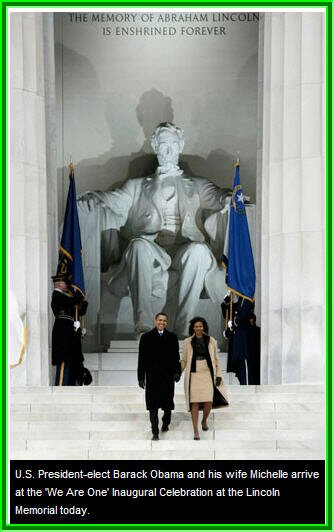
The party’s president Gerry Adams left this morning to attend the Washington DC inauguration of Mr Obama.
Mr Adams said the incoming US president had pledged action on a range of issues of importance to people in Ireland and he said Sinn Féin would seek to build a positive relationship with the Obama administration.
The Sinn Féin leader met Mr Obama in the run-up to the US presidential election campaign and today as he left for the US, Mr Adams paid tribute to the role America has played in ending the Troubles.
“The United States has played a consistently significant role in the Irish peace process over the last decade,” he said.
“President elect Obama has already committed to continuing US support for the Irish peace process.
“The new US President has also made positive comments on trade and investment, and has acknowledged the need for immigration reform.
“Sinn Féin is committed to working with Irish America toward building on the positive relationship we have with both Democrats and Republicans and with the new administration in Washington.”
Mr Adams added: “The coming into office of the Obama administration will present many positive new opportunities.”
PA
http://www.belfasttelegraph.co.uk/news/local-national/churchesrsquo-relations-warm-at-drumcree-14144283.html
Saturday, 17 January 2009
The two parishes of Drumcree in Portadown — Catholic and Church of Ireland — are moving closer, courtesy of their clerics.
Fr Michael O’Dwyer and the Rev Gary Galway of the neighbouring parishes are joint chairmen of the town’s Churches Together organisation which embraces most of the main denominations in the area.
And while the ministers are still leaving it to others to sort out the Drumcree Orange march situation, they feel that cross-community relationships in Portadown are improving slowly but surely.
Fr O’Dwyer, who was robbed of £1,000 charity money at knifepoint in his parochial house earlier this week, is delighted at the personal support he received from his Church of Ireland neighbours throughout the town, including his fellow chairman.
He said: “I’m delighted to serve with Gary, and with other Protestant and Roman Catholic clergy on the group. They have been so sympathetic to me since the robbery, and we all notice a slow thawing of relationships in the town.
“Gary was a curate at St Mark’s in the centre of Portadown and is well respected in the area. It’s a delight working with him.”
Mr Galway said he had been involved in the Portadown Churches Together group — where seven churches are involved — and was pleased to serve as chairman with Fr O’Dwyer. “Our aim is to bring Christian people together in Portadown and we have a number of project going, including a Prayer Week.
“And as far as the July Orange service in Drumcree is concerned, I — like my predecessor John Pickering — will not close the doors of my church to anyone. I know John Pickering was placed under pressure for his stance, but I agreed with him and I will do the same.”
And an Orange source said: “We don’t think that the Rev Galway will be as closely involved in the Drumcree march situation as his predecessor John Pickering, but we see no problem with him taking the various Orange services or with the chairmanship. The Garvaghy Road Residents Coalition refusing to meet the Portadown District for face-to-face talks is the major obstacle as far as we are concerned.”
Mr Pickering, who retired last year, is writing a book about his experiences in Drumcree.
http://www.belfasttelegraph.co.uk/news/local-national/paisley-rebuked-for-wearing-a-shamrock-by-dup-members-14144287.html
By Noel McAdam
Saturday, 17 January 2009
Ian Paisley has told how he was rebuked for wearing a St Patrick’s shamrock — by members of his own party.
And he said DUP members objected to his call for St Patrick’s Day to be made a public holiday in Northern Ireland.
The former First Minister also quipped that if Ulster Scots becomes more widely used, people would “need a dictionary”.
His comments came in an interview on Belfast’s Irish language radio station Raidió Fáilte 107.1fm, broadcast yesterday, in which the DUP leader spoke of his long admiration for Saint Patrick and Saint Columba.
But while he said he wanted both Protestants and Catholics to recognise their common Christian heritage, Mr Paisley was not so sure the saints could act as unifiers.
“Ulster people are strange people,” Mr Paisley told interviewer Caoimhe Ní Chathail.
“I have had DUP people objecting to me wearing a St Patrick's shamrock on St Patrick's Day. I have people from my own party who objected to me saying it should be made a public holiday.”
When there was that criticism “from your own side of the fence” the North Belfast MP added, it showed the difficulties surrounding acceptance of Irish by unionists.
The former Free Presbyterian Moderator, who once said he always celebrates the day by preaching about St Patrick, revealed last year that he would like to see March 17 as an Ireland-wide holiday.
He also made the proposal in the House of Commons.
The short exchange was a scoop for the station, which has been in operation for around two and a half years.
Station manager Fergus Ó hÍr said it formed the station’s ongoing efforts to bring the Irish language to all parts of the community and show that it is “part of the cultural heritage of everyone and does not belong to one section or group in society”.
http://www.independent.ie/opinion/analysis/enduring-legacy-of--the-first-dail-1605854.html
Ninety years on, the parliamentary ideals of our founding fathers remain paramount, writes John A Murphy
Sunday January 18 2009
HISTORIC: The inaugural meeting of the Dail on January 21, 1919, attracted huge crowds and there was huge excitement
TUESDAY afternoon, January 21, 1919. There was an air of anticipation and high excitement around the Mansion House as the time (3.30pm) approached for the inaugural meeting of An Dail Eireann (this was how the Sinn Fein-convoked constituent assembly was referred to in the press at the time). Orderly queues formed in Dawson Street, visitors' tickets had been already distributed and the Round Room was soon crammed. Those occupying vantage points in neighbouring windows were by no means all Sinn Fein sympathisers -- they included police chiefs and several military officers.
A piquant touch was added to the occasion as a group of ex-POW Royal Dublin Fusiliers left a reception in their honour in the Mansion House just before the Sinn Fein people moved in. This caused a local trader to remark, to some laughter, "no city in Europe can beat Dublin after all!'' Inside the building there were more than twice as many journalists (from European, North American, British and Irish newspapers) as the newly-elected representatives.
The background to this dramatic event was the UK general election of December 1918, when Sinn Fein secured 73 of the 105 (single-seat) constituencies in all of Ireland. In its manifesto, the organisation had declared it would secure a republic by, inter alia, withdrawing the Irish MPs from Westminster and setting up an independent constituent assembly in Ireland. (This strategy had been mooted, but never acted upon, by some 19th century nationalists). Emboldened by its triumph at the polls, Sinn Fein now called on all elected Irish representatives to attend the inaugural meeting of a single-chamber Dail Eireann. The invitation was, of course, ignored by the unionists.
As the meeting began, there was loud applause when the elected members took their seats. As Ceann Comhairle, Cathal Brugha dominated the two-hour session and set the uncompromising tone. A severely-wounded hero of 1916 and destined to die in a Cu Chulainn-like last stand at the start of the Civil War, his was hardly likely to be the voice of moderation on that opening day, especially in the absence of mainstream leaders like the imprisoned Arthur Griffith and Eamon de Valera. The Irish Times noted that the Sinn Fein representatives were nearly "all young men, there being no grey hairs among them and very few wrinkled brows''. They were obviously highly conscious of the historic significance of the event as they set about, in Cathal Brugha's words, "the most important task since the Gaels came to Ireland''.
The emotional fusion of religion and nationalism which had characterised Easter Week was also strongly evident in the rhetoric of the First Dail. This was not crawthumping but a fervent and self-righteous conviction that God was on the side of the revolutionaries and that their enterprise was obair naomtha, "holy work''.
Significantly also, given the formative influence of the Gaelic League on that generation, Irish was the dominant medium of the proceedings. This meant, according to the Irish Times, that three-quarters of those present were "completely at sea''.
The roll call of all 105 members (including unionists and the handful of surviving Redmondites) provoked some laughter when Sir Edward Carson, among others, was solemnly recorded as being as lathair (absent) suggesting somehow that he had a cold or missed the bus.
Only 27 Sinn Fein members were present, the majority being listed as imprisoned or on the run.
There was perhaps some make-believe, then and thereafter, about the public use of Irish. Certainly, as attendances increased at subsequent sessions of the First Dail (52 members were present at the meeting on April 1) English came to dominate the proceedings and it was soon ordained that "all notices and pronouncements were to be issued bilingually''. The sending of invitations to unionists and the dutiful intonation of their names in a roll call smacked of theatrical posturing. Sinn Fein was continuing the nationalist self-deception that unionists would turn out some day to be nationalists, once the British scales had fallen from their eyes.
The most important document of that historic first day was the Declaration of Independence. This took the form of ratifying (to great applause) "the establishment of the Irish Republic . . . proclaimed on Easter Monday 1916 by the Irish Republican Army'' and now receiving the allegiance of "the overwhelming majority'' of the Irish people. Two points should be emphasised. First, what de Valera was to call the "straitjacket'' of the Republic was now in place, making future constitutional compromise not only difficult but open to the charge of treachery. Secondly, the Assembly was claiming that its authority was grounded in the 1916 proclamation (and the blood-sacrifice mandate) as much as in the democratic credentials of the 1918 election.
The seeds of further ambivalence lay in an occurrence in Co Tipperary on the same day as the Dail opening. This was what the Irish Times called the "foul murder'' of two policemen by armed Volunteers. Needless to say, the Dail deputies were not aware of, still less responsible for, this event but it was to lead in a very short time to the most important question facing the fledgling state: would a civilian Dail government be able to assert its authority over the gunmen?
Other business transacted on opening day included the drafting of a short, provisional constitution; the issuing of a rhetorically high-minded message "to the free nations of the world''; and the adoption of a Democratic Programme, unanimously approved without debate.
This document could have been more appropriately titled a "social'' or even a "socialist programme''. It was a concession to Labour which had stood aside in the 1918 election but which now wanted its aspirations recognised by the one-party Sinn Fein Dail.
Irish nationalists in general had always believed that an independent Ireland would be prosperous and just; Sinn Fein's social policy specifically envisaged the development of national resources for the public good; the Democratic Programme now went much further. It was a radical manifesto with some striking phrases, e.g. "no child shall suffer hunger or cold from lack of food, clothing or shelter''. IRB leaders, like P S O'Hegarty, single-mindedly concerned with ending British rule, dismissed it as "socialist theoretical high-sounding jargon''. It hardly reflected the mind of a lower middle-class Dail and certainly not the sentiments of a recently-established peasant proprietorship. This historical context should be kept in mind by latter-day commentators who mistakenly regard the Democratic Programme as a mainstream founding-fathers' ideal from which there has been a shameful falling away.
The British authorities had tolerated the public -- and widely reported -- opening ceremonies of Dail Eireann but they banned the Assembly from September 1919. The Dail and its government went underground and in spite of increasingly fraught circumstances in 1920-21, performed impressively in setting up an alternative jurisdiction in local government, the administration of the law and public financing. The Second Dail, returned without a contest in May 1921, continued to receive popular nationalist support until the Treaty split and Civil War, 1922-23.
We tend to think of the parliamentary and physical-force traditions as diametrically opposite dynamics in Irish nationalism.
Yet over the decades since independence, successive "republican'' groups, while refusing to recognise the "Free State'' and its institutions, have bizarrely insisted on their allegiance to the First and Second Dails as the wellspring of legitimate political authority in Ireland. Unreal and perverse though this mentality may be, it unwittingly acknowledges the priority of the parliamentary tradition as the most enduring political force in our history.
And so it is appropriate that on Wednesday, January 21, and despite the current disenchantment with politics in this country, the Oireachtas should honour the idealism of our native parliamentary founding fathers, 90 years on.
John A Murphy is Emeritus Professor of Irish History at UCC
Irish Northern Aid
News

 |
||||